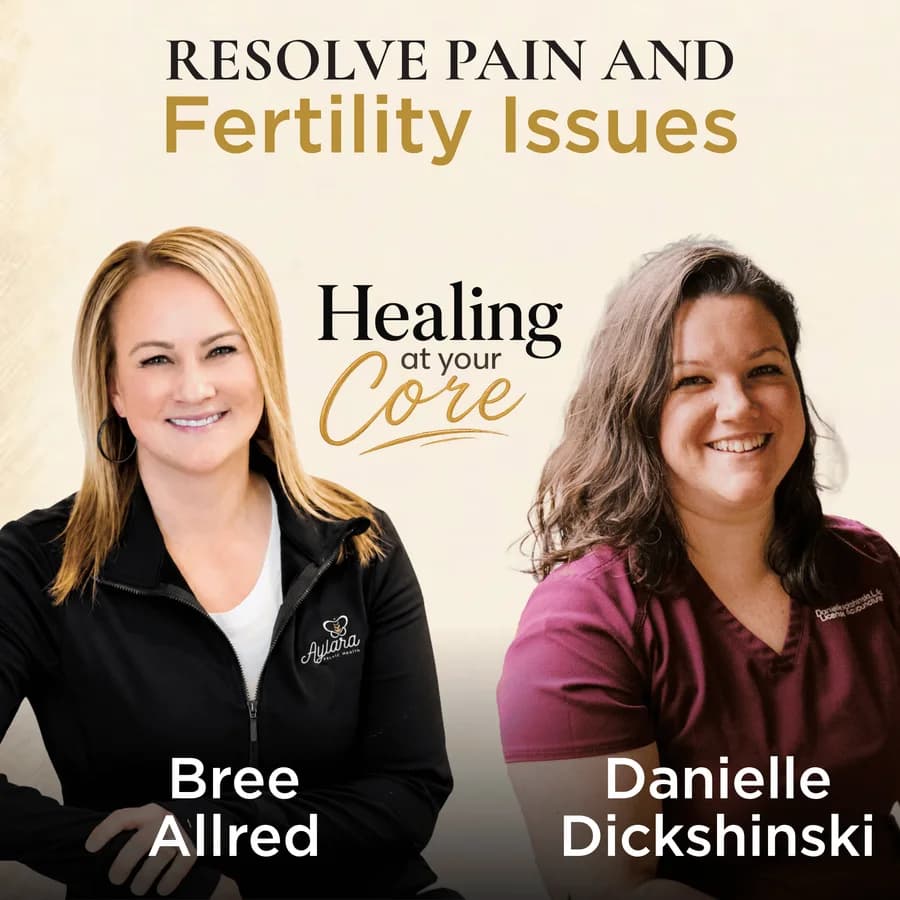
Bree Allred: [00:00:05] [00:00:10] [00:00:15] [00:00:20] [00:00:25] Welcome to Healing at Your Core. I'm Dr. Bri Allred, and we're so [00:00:30] excited to have our guest, Danielle Dickshinski. And she's an acupuncturist and [00:00:35] Chinese medicine specialist, and also has some certifications in energy work, and [00:00:40] reiki, and trauma. And so we're really excited to delve into this.
Today we're gonna be talking [00:00:45] about endometriosis pain and how traditional [00:00:50] Chinese medicine, uh, can help with endometriosis. So Danielle, go ahead and [00:00:55] introduce yourself and, uh, just give them a little bit more of your background.
Danielle: Hi everyone. My name is [00:01:00] Danielle Dickshinski. I am a licensed acupuncturist, Chinese herbal, or Chinese [00:01:05] traditional Chinese medicine practitioner is the terminology. Uh, my own Thriving with Eastern Medicine [00:01:10] Acupuncture. I've been practicing for over 10 years. I specialize in reproductive health [00:01:15] optimization.
That include optimizing cycles, endometriosis, PCOS, [00:01:20] fertility, male factor infertility, unexplained infertility, [00:01:25] chronic pain, autoimmunity management as well. So I like to blend Eastern medicine, [00:01:30] which is traditional Chinese medicine, acupuncture. Reiki I've been doing for 17 years, so [00:01:35] that helps with regulating the nervous system and calming inflammation pathways, and I like to [00:01:40] empower women with improving their quality of life so they don't have to suffer for so long
Bree Allred: I'm excited [00:01:45] to, um, get this discussion going. Uh, [00:01:50] so first thing that we're gonna talk about is can acupuncture actually help [00:01:55] endometriosis pain?
Danielle: It can help... Go ahead. Sorry.
Bree Allred: yeah, sorry, go ahead. It just [00:02:00] like ... That's really our biggest question there, right? Is, is can acupuncture help with [00:02:05] endometriosis pain, or let's even just kind of give a bigger term of like chronic pelvic [00:02:10] pain
Danielle: Yes. It can help with managing the endometriosis pain [00:02:15] or the pelvic pain that leads on the downregulation that happens at the end, 'cause [00:02:20] endometriosis starts with the lesions, then inflammation builds up over time, and the body's responding and guarding, [00:02:25] then it'll lead to the chronic pain. And so it helps with different steps leading [00:02:30] up to that point of the chronic pain that a woman's experiencing and when they're diagnosed with endometriosis as [00:02:35] well
Bree Allred: That's great. Tell me a little bit... Help us understand and our [00:02:40] viewers understand how acupuncture can help address pain
Danielle: [00:02:45] Yes. It can help with multilayered approach, but the way it [00:02:50] works is acupuncture helps ... Let's think. [00:02:55] Acupuncture helps with regulating the immune system. [00:03:00] So when you're putting acupuncture into the body gently, it helps regulate the immune system [00:03:05] locally, but also works through the nervous system and helps rewire the nervous system's response to [00:03:10] the pain, and that releases a whole cascade of physiology, [00:03:15] immune regulation, pain relieving chemicals that has there.
So it has a local [00:03:20] response and also a systemic response in managing the chronic pain and endometriosis there. [00:03:25] And so it's simple, too, of acupuncture's different points. There's [00:03:30] a whole world of it
Bree Allred: Yeah. Yeah. Um, [00:03:35] would you say that you're treating endometriosis itself, or are you changing [00:03:40] the body's process of experiencing the pain that the endometriosis causes?
Danielle: There's a [00:03:45] duality there. For right now, based on the clinic and the response we're [00:03:50] seeing there and also study or research, it's helped changing the body's experience and [00:03:55] processing of pain. Kind of how I explained there's a local response with acupuncture, with the [00:04:00] body responding to it right when you're putting it in, and also systemically of how the nervous system's [00:04:05] perceiving and responding to the treatment.
And herbal medicine, which [00:04:10] is a whole other category we can get into later, is that there's some studies are showing that it is influencing [00:04:15] the inflammatory and immune system response, um, that may affect the [00:04:20] lesions, but we need more studies for that. So I will say more changing the body's experience and [00:04:25] processing of pain right now
Bree Allred: Yeah. Um, I think it can be helpful too, just to [00:04:30] explain a little bit about how we're still learning so much about pain in the body. I think we both, [00:04:35] right? It's like science is still trying to figure pain out, and it's so complex, and the more that we learn, the [00:04:40] more we know we don't know. Uh, but it's really a neat thing that we have...
It's like there's two [00:04:45] parts to pain. One is what's happening locally, um, where there's some receptors that are [00:04:50] d- picking up that it's like, "Hey, there's something going on here." And then the second part of [00:04:55] that is the brain and how it's perceiving the signals that are being sent by the local tissues. [00:05:00] So we've got these two parts.
It's like, one, okay, what's being produced locally, and two, how's the [00:05:05] brain perceiving d- that signal that's being sent, right? And so you're saying acupuncture can [00:05:10] actually affect both ends of that relay system to where it's like, okay, I'm sending a [00:05:15] signal, I'm receiving a signal, and acupuncture is addressing both of those areas.
Danielle: [00:05:20] Yes. And like when we say in our medicine is we're addressing the symptomology the person's experiencing and their quality of life and the [00:05:25] pain, and also the root cause. And so what is the root or the environment in which the [00:05:30] endometriosis is in? So it hits from both ends all the time when we're doing treatment.
Bree Allred: [00:05:35] Yeah. Can you go in a little bit more about how acupuncture is treating the nervous system? Like [00:05:40] what changes, what happens there? How is it treating the nervous system?
Danielle: So I'll [00:05:45] give a brief of like people don't understand when you put a needle, a sterile, you know, solid [00:05:50] filiform needle we call it, into the body, how is that even working? So first you have to understand that there are [00:05:55] channels or meridians starting at the fingertips or toes, and they go from the surface of the skin and then they go deeper [00:06:00] in.
And once you go from the elbows and knees, they go deeper in and then they start connecting to the organ [00:06:05] system, the cardiovascular system, lymphatic, nervous system. Everything is a whole highway and an [00:06:10] internal network. So when I'm doing select points of acupuncture, each [00:06:15] point has a treatment purpose and does have a physiological effect locally and also relating to [00:06:20] the organ system that point is related to.
And so when you do a combination of those points, [00:06:25] you're having a treatment purpose and that internal effect locally in the full system. [00:06:30] And so you are influencing the channels and meridians which run between the skin and the muscles, which is in the [00:06:35] fascia here. And there's a whole system of that, that I'm trying [00:06:40] to introduce that so people understand it's not just bing, bing, bing, we're putting it in and having an influence.[00:06:45]
And so we kind of look at it almost like internal medicine when it comes with the acupuncture too. We're not just [00:06:50] influencing the muscles or the fascia. We can talk about that too, but we're also relating to [00:06:55] how the body's chemistry is responding to it
Bree Allred: Yeah. [00:07:00] Um, tell me a little bit on how acupuncture can then affect a little more the [00:07:05] local response, like the muscles, the tissue, the fascia that you were alluding to
Danielle: Absolutely. [00:07:10] Good transition. Um, so best way, I'm very kinesthetic, so, like, when you [00:07:15] see, say, is there a trigger point here, right? Say, if I'm having... This is my leg. I [00:07:20] have pelvic chronic pain in the pelvis. It can go down to the back, the hips. There are [00:07:25] certain points and channels that come up from the ankles up the leg that can influence the whole entire pelvis.[00:07:30]
So you can either do points locally in those areas or also distal, which is [00:07:35] away from that area. I do a combination of both. When you put the acupuncture in, [00:07:40] you're not even going so deep. You're literally going millimeters if that's the [00:07:45] case. And so you're working in the fascia, which we call the San [00:07:50] Jiao or the triple warmer.
We've had that for a thousand years as a definition, and they sci- Was it Western [00:07:55] science has discovered that a year or two ago called the interstitium. And so acupuncture has a [00:08:00] huge interplay in that system there, which is right in that surface layer. So [00:08:05] that is a whole network on the cellular level, on the inflammation, the immune response.
[00:08:10] When you go to the muscular level, you're influencing the motor plates, you're influencing the trigger points, [00:08:15] um, muscles that are not, the fibers are knotted together that are creating a pain response. So when [00:08:20] there's inflammation, say the endometrial le- lesions grow, they have their [00:08:25] own network of vasculature, and that can affect and torsion of the ovaries, [00:08:30] the uterus, the pelvic bowl.
That can radiate [00:08:35] to the hip, the back, the lower hip, you know, inner thighs. There's a lot of symptomology women will say I have [00:08:40] with painful periods. And so you can release locally with the [00:08:45] muscles attached to that, the fascia attached to that by trigger pointing. [00:08:50] Um, people use dry needling. We call it orthopedic acupuncture.
It's a whole system of pain management in [00:08:55] that way, and then also points that go more internally to those organ systems, [00:09:00] too
Bree Allred: Yeah. And where you kind of brought it up, I'm like, as a physical therapist here in the state of Utah, I [00:09:05] can do some dry needling. I am literally just affecting that. I am not treating [00:09:10] meridians, I am not treating, didn't mean the whole organ system with my... I'm like, there's very much a [00:09:15] distinction between acupuncture and physical therapists that are dry needling as I'm looking at the [00:09:20] musculature trigger points, and occasionally some of the fascia.
But I am not [00:09:25] targeting meridians, didn't, and all of that aspect of treatment there. [00:09:30] Yes. Um, and just a way that I explain it to a lot of people when we're talking about trigger points, I'll use [00:09:35] my overalls here as an example. But it's like, if I twist, didn't mean right here, [00:09:40] and pull on that, like you can see it's like pulling on my strap.
There's some wrinkles that are coming [00:09:45] down here, and it's like, oh, you can see that. Like, it's, it's pulling on [00:09:50] different tissues when we've got something that's restricted in one area. And I think that's a very simple [00:09:55] description that people can see, but it's like, oh, you put a needle in that, you release [00:10:00] that, and it allows all of these other tissues that surround it to move better
Danielle: [00:10:05] Yes. With your constriction and the torsion like you're saying, when you have constriction, there's [00:10:10] not health there. There's not good flow of circulation. Everything [00:10:15] is backlogging toxic-wise there too, and that creates more of that pain response. So when you [00:10:20] want softness and flow, that decreases the pain too in the tissues
Bree Allred: [00:10:25] Yeah. Um, tell us a little bit about if we have a [00:10:30] client that's experiencing kind of pain throughout the month, right? That might vary based [00:10:35] on their menstrual cycle. Does that change what you're doing?
Danielle: Yes, it does. [00:10:40] So there is different approaches with acupuncture. You can j- do general pain, but [00:10:45] if they are having pain, I've seen it with ovulation and probably a few [00:10:50] days or a week before their period, depending on how exacerbated endometriosis is and their [00:10:55] chronic pelvic pain. So usually, if they're first coming to me, we're seeing them once a week, [00:11:00] and the point selection that you use is different each week 'cause we're matching their [00:11:05] hormonal cycle where, you know, and pain response as well.
And so we're trying to do it, [00:11:10] like, after their period, after they're done bleeding, especially during ovulation, the luteal phase, which [00:11:15] is like week three, and then right before their period. And you want to do that [00:11:20] weekly for a couple months, and you wanna see the report of how ovulation is and how their period [00:11:25] is, the experience has been for them.
It usually gets better. But we, we change the type of points, whether we're [00:11:30] using local lower abdominal points, um, you know, leg and thigh points [00:11:35] or lower back, but I'm always changing them foundationally each [00:11:40] week
Bree Allred: Based on where they're at in that cycle. Yeah. No, you're good. Um,
Danielle: Yes, based on where they're at their cycle. Yeah, I have to finish that [00:11:45] sentence.
Bree Allred: how quickly do you say that your patients will notice [00:11:50] a change? So somebody comes to see you, and granted I know this is a very generalized question, 'cause, [00:11:55] um, like when people ask me that question for PT it's like, "Oh, well, it depends. Like how chronic [00:12:00] are these, and how long have you been dealing with them, and, you know, what have you [00:12:05] done to address them, and how intense are they?"
But if you had to kinda give a general, do, [00:12:10] what would you say is, is a typical timeline of response for someone? And if you [00:12:15] have to say kind of, do you know what I mean, like this is a new issue, this is an acute issue. If you say this is kinda [00:12:20] like a chronic issue, I can understand that that may things, may vary
Danielle: [00:12:25] I'll go from chronic to acute because when it's more chronic, 'cause most women are
[00:12:30] not s- diagnosed endometriosis seven to 10 years in of suffering, and [00:12:35] that's the hardest part. When it's that intense or that developed in that pain [00:12:40] experience, I would say once a week for three months because you wanna give it at least three [00:12:45] cycles worth to see how it improves. And I try to create general expectation based on, like, [00:12:50] research and kind of, like, what I've experienced as a clinician, and it's about, I would say, 60% [00:12:55] better in the pelvic pain and the experience of dysmenorrhea probably by the second [00:13:00] month.
And then we try to see how the third mon- third month is to optimize. If we need to maintain, we'll probably [00:13:05] go ovulation right before their period, another couple months after that. And then when [00:13:10] I've seen subacute, and I'm talking about teenagers, like we're seeing a lot of painful periods with preteens [00:13:15] with the genetics of endometriosis or something runs in the family, so I'm trying to get them [00:13:20] diagnosed earlier on, and I see them coming in, and I've seen them respond the fastest.
I've [00:13:25] seen them where I'm treating them maybe twice a month and right by ovulation [00:13:30] for their period, and their periods are probably within two months worth of that, so that's four sessions, they're down [00:13:35] to, like, 70% improvement. So it's just really interesting if you catch it earlier on, they have a better pain re- [00:13:40] like, lower pain.
Bree Allred: Yeah. And there is a thing called centralization of pain, [00:13:45] which means it's more nervous system based rather than, um, what's happening in your [00:13:50] system. And I think the more centralization we have, the longer it takes [00:13:55] to reverse. So the more that it's like, oh, the brain ... I explained it a little bit that our brain [00:14:00] only has so much juice that it can expend in a day, right?
So much energy. And it's [00:14:05] trying to decrease the energy costs of what it we're, it's doing in a day. So it will s- it will [00:14:10] push stuff into more of an automatic like, "Oh, this has been sending this [00:14:15] signal for three months. Okay, we're just gonna put it on autopilot, and we're gonna sense that signal because [00:14:20] I've, I've noticed that it's like it's not worth, um, expending energy on to recognize it and [00:14:25] deal with it," that it's like, "Oh, okay, it's just on autopilot."
That's more [00:14:30] centralization. And, um, the more centralized things are, the longer that it takes to be able to [00:14:35] improve it.
Danielle: There is
Bree Allred: We have to get the brain to pull it out of autopilot so that we can change [00:14:40] what it's, what it's sensing.
Danielle: Yes, and that's correct. In the world of trauma-informed care, [00:14:45] we use the word of will-- window of tolerance, and so the nervous system's used to fight, flight, [00:14:50] freeze, and fawning responses, which is always a sympathetic dominance or even [00:14:55] paras-parasympathetic shutdown. And so then you have the rest, digest, and sex, and things like that.
[00:15:00] They're more peaceful in this space. But your window of tolerance when you have, like you said, the centralization of that [00:15:05] pain response over time, your body almost encapsulates that pain experience to [00:15:10] protect itself. It's a neuroprotective status, and so a lot of times when you're-- [00:15:15] it's like kind of complex PTSD kind of thing, too, especially with endometriosis.
And so your window of tolerance is [00:15:20] very narrow, and so you can't tolerate as much. You can't tolerate a certain pain, or you're used to a certain [00:15:25] level of it, and so the goal is with treatment is to help the body gain trust, let the nervous system [00:15:30] soften, and then it'll start stop decompr- you know, stop carputnal- carputnalizing.
Can [00:15:35] never say that word. And it increases the window of tolerance, and so that you have a better [00:15:40] response of, "I can deal with this pain if it's, you know, painful during this period or it's less or something stressful in my life [00:15:45] and come back to my center. Then I can rest, digest, and enjoy my quality of life and come back."
And that's a [00:15:50] capacity of health when it comes to that, too. So that's just a different perspective I have of it as well.
Bree Allred: [00:15:55] Yeah, I love that. Um, would you say that your treatments tend to [00:16:00] accumulate over time?
Danielle: Of course.
Bree Allred: Yeah
Danielle: It completely, [00:16:05] it's ... If you're expecting acupuncture to cure or fix you in one time, you're not the right fit. I know [00:16:10] that answers a question later down. But there's, if you have this chronic [00:16:15] thing that is genetic and it's been building up, even if it's a teenager having painful periods, it's gonna take more [00:16:20] than once.
And we're literally, like we just talked about, we're retraining the whole system [00:16:25] and help re-unwiring and unraveling all of this. So it takes time, and [00:16:30] things do build up after another
Bree Allred: I agree with that. So let's talk a little [00:16:35] bit more about lifestyle and maybe kind of going into your herb side of things just a little bit as [00:16:40] well, right? But, um, tell us about how food, lifestyle [00:16:45] habits, how that plays into endometriosis.
Danielle: It helps significantly. [00:16:50] Like they With, think of [00:16:55] e-endometriosis is now known, it's not just hormonal, it's more full inflammation [00:17:00] type of condition. It's an inflammation and immune system type of condition. And so [00:17:05] the immune system is centralized in the gut. Your gut is your second brain, hopefully people know that [00:17:10] by now.
And that influences our nervous system and how our brain is less [00:17:15] inflamed, and also how it can synthesize pain responses and also the lesions too. Um, [00:17:20] so lifestyle-wise, the basics is whole food, eating locally, eating in [00:17:25] season when it's safe, out of the sun or the lettuce. So [00:17:30] you wanna start with the basics there.
You wanna learn about the clean 15 and the dirty dozen. [00:17:35] There's something you go on Google, you can print it out. They update it every couple years. Put it on your fridge, and if there's [00:17:40] certain foods you like to buy, buy more of those. Um, for example, [00:17:45] apples you wanna buy organic always, 'cause they're heavily in pesticides.
Anything that has a shell [00:17:50] like, you know, bananas have the peels, avocados, things like that, those are safe to eat [00:17:55] conventionally grown. And so you wanna learn the basics of food that way, is whole foods in [00:18:00] season locally. Um, anti-inflammatory foods are gonna be your best friend. [00:18:05] So berries, high things or high antioxidants.
You don't have to go the whole super foods [00:18:10] thing. That's not true. You just... It's more variety, color of the rainbow, [00:18:15] and if you are drawn to certain ones, you can double up on what you like to eat. I like to keep nutrition [00:18:20] simple because that is the hardest thing for someone to change because it's micro habits that build up.
[00:18:25] So you wanna kind of make it a game to play and then just work towards it. When it comes [00:18:30] to like endometriosis and inflammation and in Chinese medicine, you wanna eat things that [00:18:35] are dark leafy green. You want to have more mushrooms 'cause they're good for immune [00:18:40] regulating, even if it's just like sautéing mushrooms.
That could be herbally too. There's a lot of, um, [00:18:45] mushrooms are getting more notice in the Western world for Western herbs, like lion's [00:18:50] mane, cordyceps. You can Google them and they'll tell you kinda like what they're for because they actually do [00:18:55] influence the immune system directly or give you those phytonutrients that help.
Um, [00:19:00] let's see what else. Kidney beans, any beans, legumes are really good for [00:19:05] helping with inflammation as well. But make sure you can digest them, so you have to make sure you're assimilating [00:19:10] and you're able to digest things very well 'cause a lot of times if you have endometriosis, a lot of those [00:19:15] patients have digestive or conditions that kind of match, like [00:19:20] celiac.
Yes. And so you wanna make sure you soak them. You wanna make sure they're cooked or [00:19:25] stir-fried. In Chinese medicine, we don't really believe in cold and raw things, which is really counterintuitive with [00:19:30] smooth- smoothies and salads, um, in the Western world. I say it's a balance. If [00:19:35] you're gonna do a salad, then you have a cooked protein, like a fish or a chicken or something like that.
If [00:19:40] you're gonna do a smoothie occasionally just to get something in 'cause you're busy, then you're gonna have a warm tea, a [00:19:45] bone bro- a cup of bone broth. I'm not joking. Those work really well. It's easy And some [00:19:50] people, you know, whatever you're having as a warm beverage, you know, kind of side by side with that.
But you always [00:19:55] want to eat as well to nourish your body. Like between 9:00 and 11:00, you wanna have a [00:20:00] protein-based breakfast, s- 'cause your stomach and small intestine's most active during that time. And [00:20:05] there's a lots of tidbits of information on that, but that is just, like, the
Bree Allred: So many people skip breakfast [00:20:10] and it's
Danielle: Oh, don't skip breakfast.
Bree Allred: thing for you,
Danielle: Your body will hold weight because it's [00:20:15] starving. Even if you're swelling and you have more of, like, this edema type of response with [00:20:20] endo, like you're just gonna hold the water weight, and so you need density. [00:20:25] We need nutrition. And a lot of w- women don't know that in our luteal phase, progesterone needs [00:20:30] 20% more calories, is why we have cravings, because we actually need more food for that [00:20:35] hormone to be processed more
Bree Allred: Some of that intuition, right? We actually [00:20:40] know. It's like when you're hungry, this is why. It's like you're in a different phase and your body needs a little [00:20:45] bit more. Yeah. And it's, I'm like, we as women, and I mean, we [00:20:50] could look at men too, they still cycle in a day, right? So they may have a time of day that they're a little bit more hungry [00:20:55] or things there.
But women, it's like our bodies are changing so much throughout the month, and we [00:21:00] cannot d- eat the same every day, and we cannot eat the same every week and have it support [00:21:05] our system in the way that we need it to.
Danielle: Yes. It's really true. And a lot of people was at [00:21:10] the cyclic eating has been really huge on social media, like eat along with your cycle too. You [00:21:15] can do that, but you don't have to be so strict about it and restrictive 'cause if you're [00:21:20] already in pain, you don't need to live that way. But like the dark leafy greens, protein high up, [00:21:25] especially ovulation on your luteal phase needs it, and especially with these conditions we're talking about.[00:21:30]
And let me know your questions you have for herbal medicine because there's a lot of information on that [00:21:35] too.
Bree Allred: So many.
Danielle: me know.
Bree Allred: Well, let's even just go back a little bit to [00:21:40] inflammatory conditions. We're talking specifically with, um, endometriosis, but let's [00:21:45] talk maybe a little more broad. If you have somebody come in, what are the signs or [00:21:50] symptoms that you're looking at that would make somebody think like, "Oh, I've got inflammation in my body, and [00:21:55] this might be a good treatment for me"?
Danielle: Well, everyone has inflammation in their body these days, but [00:22:00] what really cascades into full on is first you're doing the medical intake. You're asking a lot of [00:22:05] questions. In Chinese medicine, we ask 10 questions. We're hitting all full body [00:22:10] systems. Um, so yes, most people are coming in for pain, but are they having brain fog?
[00:22:15] Are they having a hard time concentrating? Then I know that the blood-brain barrier might be a little bit irritated, or do they [00:22:20] get rage from ovulation and then kinda like PMDD type of inflammatory [00:22:25] response, um, with a response to certain hormones, or they're not processing it right. [00:22:30] So you look at cy- in-depth cycle analysis, too.
Symptomology, what they're saying, how are [00:22:35] they feeling, how are they transitioning each week into that as well. Do they have any [00:22:40] edema? Do they have any joint or muscle pain, too? 'Cause then I know there's inflammation in the joint systems, 'cause that can [00:22:45] work. Are they nauseous during ovulation or before their period or on day, up to day two of their [00:22:50] period is a cardinal thing I've seen for inflammation, too.
They don't have a great appetite. They have [00:22:55] low appetite, or they feel like it's a chore, so there's something shut down there, but yet they're [00:23:00] holding weight and retention. So there's definitely different symptoms of inflammation I'm [00:23:05] seeing there. Um, also, if they're mucusy a lot, then I know there, there's different types [00:23:10] of inflammation in Chinese medicine.
We call it damp heat syndrome, and we call it, uh, [00:23:15] damp heat, which is more like the excess, the redness, like more of that inflamed type of response [00:23:20] that
Bree Allred: What you would typically think maybe when you're thinking something's inflamed, you get injured, you get that big, or you [00:23:25] get a wasp sting and you get that response.
Danielle: Yep, the hives.
Bree Allred: yeah
Danielle: Yep. [00:23:30] So it's like that redness, the hives, the itching, the discomfort, the fever, that is like the heat kind of thing, [00:23:35] too.
And then we have damp cold, which is more of like they get more swelling in their joints, they get more [00:23:40] pain, they get more brain fog, lethargic, slower digestion, puffy tongue, [00:23:45] um, when it's like cold and rainy and wet and cold, like wintertime outside. So it's actually a, s- like [00:23:50] a deficient cold type of inflama- inflammatory response as well.
And [00:23:55] another cardinal thing you can ask is like, what's their body temperature like? What is their metabolic [00:24:00] system? Are they running cold? Are they running hot? Are they pretty neutral in the controlled [00:24:05] temperature space, or do they have cold hands and feet? Or are they cold below and hot above? I've heard that a lot with [00:24:10] my perimenopause patients, too.
So it's deciphering a lot of information and [00:24:15] symptoms and sorting, and then you get the pattern, and then you can approach with treatment. [00:24:20] Yeah
Bree Allred: Um, okay. Now going into [00:24:25] the herbs. Like, tell me, is that... And this is my [00:24:30] lack of knowledge, and I think it could be helpful, but do all acupuncturists do [00:24:35] herbology as well, or is that an additional thing that you've become certified in?
Danielle: Um, [00:24:40] no. So in education pathway with acupuncture, you [00:24:45] are... You get a master's in science. I have a master in science in acupuncture. You get a baseline of [00:24:50] a couple traditional Chinese medicine classes, and then you will also, um, [00:24:55] can do an additional degree, and it's another master's degree in traditional Chinese [00:25:00] herbology.
And so some will do it that pathway as well. So some will say, "I'm a licensed [00:25:05] acupuncturist," but they say, "I don't do herbal medicine." There's a handful of states that require you to have that master's degree in [00:25:10] traditional Chinese medicine to practice prescribed herbs. Other states you can just be a lac- licensed acupuncturist [00:25:15] and then just have additional training.
So like Western... That's like traditional [00:25:20] Chinese herbology. Western herbology is more like certification programs that they have. And [00:25:25] so, like, you have to ask the acupuncturist. Usually we have a... We used to call it [00:25:30] NCCAOM, is a national licensing board, and it'll list licensed acupuncturists, and it'll also [00:25:35] say if they're a lic- you know, like certified herbalist for that too, so you can kind of see where you are in your region and see [00:25:40] how they're licensed and what their education is, 'cause you have to meet certain standards to even be on that.
[00:25:45] And so I would... So when you're interviewing them, you can ask if they do [00:25:50] both
Bree Allred: And I know there's a lot of hearsay of like, "Oh, these herbs are good for [00:25:55] people in perimenopause or good for people with endometriosis." Do you recommend [00:26:00] people start doing it places on their own where it's like, "Oh, you may be dealing with some of these symptoms. Maybe [00:26:05] try some of these over-the-counter herbs"?
Or is it like, no, it's really beneficial to go [00:26:10] and do it... See someone like yourself that has additional training to [00:26:15] get more guidance on that?
Danielle: Yeah, it's a great question. It's a mix of both. I am more [00:26:20] supporting accessibility in medicine for people, and so [00:26:25] honestly, like, and especially in the North America with Western herbalism, which we know about, if you have hot [00:26:30] flashes, take black cohosh. Don't take black cohosh unless you need to.
But, like, there's, like, these signature, you [00:26:35] have this symptom, take this herb. Herbal medicine is not that simple. But I also encourage people to [00:26:40] play and see. Like, there's different tiers of safety with herbs. There's the culinary we use to cook a [00:26:45] lot, turmeric, for example, things like that. And then we have moderate level of [00:26:50] affecting, you know, for, like, these conditions that you might want to work with someone like me [00:26:55] that's certified and licensed because the important things to consider is herbal medicine is medicine, [00:27:00] and if you're using higher doses or more frequent, or you're going more of the potent type of herbs, [00:27:05] you wanna make sure it's not interacting with any medications.
You wanna make sure you're not allergic to it. You wanna [00:27:10] make sure it's not contraindicated. Like, for example, there's a lot of herbal [00:27:15] cal- classifications called adaptogens that helps you adapt to stress, but some of those [00:27:20] herbal, like Western herbs, are not safe for those that have Hashimoto's, which is paired with endometriosis [00:27:25] sometimes.
I see a lot of formulas even at natural grocers, there's a Hashimo- Hashi- [00:27:30] Hashimoto's formula or a thyroid optimizing formula, and it has those herbs in it that actually causes [00:27:35] your thyroid storms or is counterindicated for that condition they're marketing for. So [00:27:40] you have to be careful. If it's culinary based, go ahead and play with it.
If your body's... You know, [00:27:45] there's a way I teach patients, too, if they're trying different herbs or if I'm gonna recommend and prescribe [00:27:50] something, even if I'm giving it to them, and you're sensitive to things a lot, whether it's food or [00:27:55] allergies or you don't know, what you can do is take the herb, whether it's loose leaf or a capsule, and break [00:28:00] it.
Put it on your skin for a moment and see if you have actual response. If you're, [00:28:05] like, redness or itching or something, then you're not supposed to take it. If you don't have a response after [00:28:10] a few minutes, then you can take a little bit, put it inside your cheek, and if you have tingling of the [00:28:15] lips or any symptoms or some scratch of your throat, take it out immediately, and you're not gonna use it, and [00:28:20] you don't leave it in
Bree Allred: Versus having it be ingested in your whole body and you're like, "Shoot, we just have to wait for it to run [00:28:25] its course before it's
Danielle: No. That's the cool thing with herbs is you can kinda see if it's kinda [00:28:30] safer for you, then, like, give it two, three weeks and we'll find out if it works for you. And if you [00:28:35] don't have those responses, then yeah, take a lower dose, see how you do for a couple days, keep that dose low, [00:28:40] and if you're good for a week, then we'll go up to the medium level of dose that you can handle, and that's how I usually prescribe things, [00:28:45] especially if people have a history of being sensitive to herbal medicine.
Bree Allred: Yeah. And I think you really [00:28:50] touched on it as far as, like, when you're prescribing herbs, it is definitely important [00:28:55] that your medical providers also know if you're taking some herbal supplements or [00:29:00] herbal prescriptions from somebody like yourself, because they can interact with things so differently, and [00:29:05] they can interact with medications.
And it's like, yes, it's important, 'cause a lot of people are like, "Oh, I'm just [00:29:10] taking," didn't even ... "some herbal supplements." And it's like, no, you need to ... Your providers need to know when y- when you're [00:29:15] taking these as well.
Danielle: They do. Even if they don't understand them, at least it's on your chart and it's documented. [00:29:20] I always say share what you're taking. Here's a list. I'll say, "Here's the ingredients list. Here's that, too." [00:29:25] Um, the other side of that sometimes, too, especially with Western doc- like MDs, especially in the [00:29:30] fertility world, if they hear you're taking Chinese herbs, they'll say, "Stop that immediately.
We know nothing about it. [00:29:35] You know, there's not enough studies to back it." And I always say, "It's my job to screen in [00:29:40] and out that whatever's interacting or what medication you're taking," say if you're doing IVF, like, "This is [00:29:45] not safe to take. We're not gonna do that," or, "This one has been clinically sound.
Let's do that, too. And so here's some [00:29:50] information to share with your doctor," to educate piece, too. So a lot of doctors don't know herbal medicine. They're [00:29:55] not experts in it, but it's okay to have a consistency in your chart and, you know, [00:30:00] knowledge in sharing that I am taking this for this, and then so that way they're cautious with what they prescribe as well, and [00:30:05] vice versa for us.
Bree Allred: Yeah. And I do think there's some things that we're getting better, right? With [00:30:10] AI and with electronic systems, at least it might be picking up some interactions that maybe the [00:30:15] physician's not aware of or your pharmacist is not aware of, but it may pick that up as well.
Danielle: Yes
Bree Allred: [00:30:20] That's great. Okay, let's move into fertility.
Now, I know this is, like, a [00:30:25] passion of yours, and you get excellent results with it, and I'm like, if you're looking for a girl, [00:30:30] I'm like, "Danielle is your lady." She does so many amazing things for [00:30:35] fertility. So let's talk a little bit about doing it cycles, 'cause they feed into that a little bit, [00:30:40] and fertility, and kind of how acupuncture can help with fertility.
Danielle: Acupuncture can help [00:30:45] immensely. I would say traditional Chinese medicine can help immensely, and like acupuncture [00:30:50] is one that we'll use consistently and herbal medicine too if it, uh, is appropriate for what the person is [00:30:55] experiencing. But I mean, there's so much we can talk about fertility, but it can help with [00:31:00] people naturally trying to conceive.
It also can help complement or integrate is a good word I like to [00:31:05] use if you're gonna use REI, which is reproductive technology like IVF and IUI [00:31:10] or if you need to do things like that. And so you kinda can plug in this medicine however you need [00:31:15] to. And so, I mean, in the topic of like cycles, like I can...[00:31:20]
Yes, I see women weekly. Say if they're, "You've been trying for three to six months and it's not [00:31:25] happening naturally," I like to do a functional med integrative approach, so I'm looking at what [00:31:30] labs have you had done. Did you do any preconceptive screening? I think everybody should do preconceptive [00:31:35] treat- screening and prep for a year before you actually start trying to have a baby, and that is [00:31:40] both your male partner and you because...
Bree Allred: talk. I'm gonna pause you
Danielle: Go ahead.
Bree Allred: people [00:31:45] would have this question. And I don't want you to give away like your secrets of your trade, but just generally, like [00:31:50] what are you focusing on in kind of those like pre-c- like preconception labs? [00:31:55] Or what, like what would somebody be like, "Okay, my provider hasn't really recommended [00:32:00] this.
Like, what should I be looking at?" And maybe some real basic things in that year before [00:32:05] you start trying to get pregnant. What types of things do you recommend people do?
Danielle: That's perfect. No, [00:32:10] this is good to get out there because I rather you have this done before you come see me. It saves us a lot of time and energy, [00:32:15] and it just helps. One, the male partner has to get a semen analysis ASAP. That is [00:32:20] the only way to tell your sperm health And so, and you might have to get it done once or [00:32:25] twice.
I like to then to go see a reproductive urologist, and sometimes they might need a [00:32:30] referral, so they might go to their GP then to that step, because I've seen them do a couple [00:32:35] samples and average it out, and then you'll see better parameters too. And you want that analysis. [00:32:40] You want it to not be just in the...
You never wanna be in the low average, even if you're in range, [00:32:45] because the WHO, they have lowered down the standard since the 1970s, and so [00:32:50] they have lowered the standard for male health. It actually should be in the medium level in those ranges for optimal [00:32:55] health, for sperm health. And also lab work for the male and female.
So you're looking at at [00:33:00] least a full thyroid panel. We're not talking just TSH, 'cause usually general will just do TSH, [00:33:05] not do free T3, free T4, TPO, thyroid antibodies. And if you have thyroid [00:33:10] antibodies, that's important to know that you can lower them down, even if the medical Western world doesn't [00:33:15] think you can.
It actually does matter to lower your risk of miscarriage as well. And [00:33:20] also, if you do get pregnant, postpartum hemorrhage and stuff like that, there is, like, complications if you [00:33:25] have Hashimoto's that you have to manage. Um, so thyroid panels for both partners, vitamin [00:33:30] D3, B12, um, general CBC with differential.
[00:33:35] Uh, iron panel. Ferritin is a big one I'm seeing with women, is that they have this [00:33:40] huge range, and so s- I think it's like, what? 15 to 100. I might be wrong, 'cause I know they're [00:33:45] starting to reassess that because people are complaining about it, is that if you're in range then they're saying, "Oh, you're good to [00:33:50] go."
But yet they're having iron deficiency symptoms because ferritin is your iron storage in your [00:33:55] liver. And so you need to be over 50, not under that. And [00:34:00] so there's, like, certain things I have seen that even a... Like, general doctors will just do a [00:34:05] CBC, uh, you know, CMP, which is like your liver, kidney function.
They'll check all [00:34:10] those. Maybe TSH. You want to go beyond that, and that's why I call it functional integrative [00:34:15] approach. You want to do more in depth, and you wanna get it done all at once. When it comes to hormonal [00:34:20] testing for women, you want, you ha- the day in your cycle, if you have regular cycles, the most [00:34:25] important.
You want to get your FSH, LH, AMH, um, estradiol, which is [00:34:30] your E2, by day three or four of your cycle. Because then [00:34:35] you can get true ratios of where it's at. Your progesterone standard tested at day 21. [00:34:40] So you want to get that done. Um, male, you wanna get estrogen, [00:34:45] testosterone, um, DHEAS for both as well. So, like, I create usually in my [00:34:50] consultation, like, I write that all out and I say, "If you want lab work, get this done."
But usually, [00:34:55] generally, like a GP, even OBGYNs, I have not seen them run those extensively like that, [00:35:00] so usually I'll give them recommendations for preconception to do that and analysis. And then [00:35:05] we can see what we're dealing with from there, and then customize the plan. Yeah.
Bree Allred: [00:35:10] That's
Danielle: that answered that.
Bree Allred: Good recommendations. Yes, I think that's awesome to be like, "Okay, here's [00:35:15] what we're looking at," and seeing where your numbers fall. And if you're-- And I think you could just generally say if you're in the low end of [00:35:20] average on any of them, it may be something that you're wanting to optimize a little bit more to increase [00:35:25] your chances of conceiving and your health
Danielle: And I would also wanna say is like people come in, I'm [00:35:30] like, "I'm taking all the supplements." And I'm like, "Stop. Don't take 10 supplements at once. You're congesting your liver and [00:35:35] it's counterintuitive, and you can't absorb as much as well with that." And so you wanna get these [00:35:40] testing first to actually see what you need for targeting supplementation or really good quality, like maybe two [00:35:45] or three of them, and then go from there too.
Bree Allred: Yeah. Great. [00:35:50] Um, amazing. Let's move into a little bit more of [00:35:55] adenomyosis. So for people who aren't familiar, this is a similar thing to [00:36:00] endometriosis, but it's inside the uterus rather than outside the uterus, right? [00:36:05] So it's some scar tissue that's developed. It is cysts that are developed inside the [00:36:10] uterus.
So, um, how can Chinese women help people with [00:36:15] adenomyosis?
Danielle: It can help lower the inflammation, lower the pain that it [00:36:20] creates a lot of pelvic pressure too. So it helps with kind of like [00:36:25] managing the pain, managing the inflammation. There is some specific herbs that [00:36:30] can possibly lower like the growth of certain things [00:36:35] internally in the uterine cavity, um, in the endometrium lining.
Um, [00:36:40] like usually if it's under six millimeters in growth, you usually, you can shrink it a little bit with [00:36:45] target Chinese herbal formula. I've seen that with a pre and post. We need [00:36:50] more studies on that, but it is more promising where it can kind of... 'cause you're taking this medicine [00:36:55] internally and it helps with that environment too.
Bree Allred: Yeah. Yeah. [00:37:00] So let's talk about where do you feel that your role fits in an [00:37:05] endometriosis treatment plan versus like, oh, you're just needing to go to [00:37:10] surgery. At what ... Right? Like, kind of these like we ... I would like ... Physical therapy and [00:37:15] acupuncture, we would both fall a little bit more on the conservative, well, completely on the conservative end of treatment, [00:37:20] meaning it's not invasive.
You're not, you're not doing a surgery. We're not cutting things out [00:37:25] of you. We're not doing things there. We're, we're doing it without a surgical treatment. But at what [00:37:30] point do you feel, do ... Is acupuncture's limitations in treatment, and when do you feel [00:37:35] maybe somebody needs to go for a surgical consultation?
Danielle: It's been so interesting 'cause I've been in a [00:37:40] tran- I've been transitioning in my stance on this lately too, because [00:37:45] I think one is what the intention and goal of the patient is. What do they truly want? [00:37:50] And a lot of them that have endometriosis, they're really well-educated. They've done a lot of research.
They [00:37:55] know how to advocate, and a lot of them are just tired and, and pain. And so I [00:38:00] think with this medicine and how I stand is very tran- it kind of [00:38:05] helps with the whole process. I do a lot of co-care, so whether it's before or after surgery, a lot [00:38:10] of times it's like, "I don't... I think I have endo, but I'm not sure."
And I am, like, this [00:38:15] gatekeeper of resources, and it's my job to give them resources, whether it's Western or Eastern. [00:38:20] And so I just send them straight to an endometrial incision specialist. I [00:38:25] don't recommend them going to OBGYNs for incision s- surgery. Go to the specialists
Bree Allred: [00:38:30] I would agree with that. It's like you're doing, you're, you're setting yourself up to where it's like [00:38:35] there's so much in depth that you need to know about endo that you need to be with a specialist. [00:38:40] You do. Versus an OBGYN. They're amazing, and I love them. They're phenomenal [00:38:45] doctors, but they're delivering babies.
They're doing other surgeries. They are not experts in [00:38:50] endometriosis care, and so I agree with you on that. That's like you need to find an endometriosis [00:38:55] excisional specialist.
Yeah
Danielle: And I send them right to them. If they need, I'll say, "Call the [00:39:00] office. You need a referral, then we'll see if we can send the referral, or your pelvic floor PT doctor can send the [00:39:05] referral in," or we try to get-- try to minimize the steps as possible because they've already been through a [00:39:10] lot. So I just send them right to the source.
I actually do encourage if they want to do surgery and they're in a lot of [00:39:15] pain, we'll prep them for surgery. If we can't manage it with the acupuncture after like, you know, [00:39:20] that three-month timeframe that I'm seeing and herbs or help managing it, then I'm gonna say, "You might [00:39:25] need to go to the specialist to see if you need to get that, you know, get surgery again or get [00:39:30] that...
See if they missed anything or anything has regrown, and then we can help you with post-recovery." Because I [00:39:35] think that is the best tool that they have for right now, depending on the type, especially the invasive type of [00:39:40] endometrial lesions that they have right now
Bree Allred: That's great. Uh, [00:39:45] tell me a little bit more about your role in healing after surgery. What does that look like?
Danielle: [00:39:50] Oh, so much fun. Um, usually I wait till you get cleared, so I, like I don't wanna see you [00:39:55] for six weeks. I want you to rest. I want you to be at home. You know, usually if they're cleared from like that two week [00:40:00] and they're feeling better, I might see them probably about four weeks out, four to six for when they feel [00:40:05] comfortable.
And most of the time it's for those that are trying to get pregnant, so [00:40:10] I will see them and I'm like, "No, you have endometriosis. I can see the signs," 'cause the guidelines have been updated [00:40:15] to screen symptomology-wise, too. And so they get the surgery. We were right, they had [00:40:20] endo. So now the goal is to minimize the regrowth and minimize inflammation so [00:40:25] that they can reach their goal of getting pregnant.
And a lot of times they wanna do it naturally or they're working with [00:40:30] IVF. So that's where I come into play a lot is that I'm keeping inflammation down, I'm [00:40:35] keeping things optimized in the hormonal cascade and, you know, just helping [00:40:40] boost the way we can. And if they have any like scar tissue pain [00:40:45] after, you know, I make sure everything's sealed and healed, not red, anything like that, and you can [00:40:50] lightly do some acupuncture around the incision sites, too, to help with that
Bree Allred: [00:40:55] Yeah. Tell me then your thoughts on acupuncture and needling and scar [00:41:00] tissue
Danielle: I love it. It's so easy to treat. So it's kind of [00:41:05] one of my favorites because you can see the faster r- responses to that, whether it's C-section, [00:41:10] whether it's a full mommy makeover, tummy tuck, I've seen those too. Um, you know, [00:41:15] you can see, see and feel the scar tissue around. You can see if there's a keloids as well, [00:41:20] depending on how it healed, um, and how, like you said, if you cinch it up, cinch it up and [00:41:25] twist it, and it has those wrinkle effects along that too.
And so you just do local [00:41:30] acupuncture. We call it surround the dragon technique around the scar tissue, and we'll [00:41:35] do some other points on the meridians that influences, we call it the sinews, which is, is like [00:41:40] the tissue component of healing and circulation too. But it releases [00:41:45] within, if it's a chronic thing, probably three to four sessions, maybe one to two if it's a newer surgery, and it's like [00:41:50] three most- three months post-op kind of thing.
So I just, I... It's just fun to see the results, [00:41:55] and they get relief from it too
Bree Allred: Yeah, for sure. It was an interesting discussion I was [00:42:00] having with an, a doc that does endometriosis excision, 'cause I was seeing a client [00:42:05] for specific scar tissue, da-da, um, issues. And [00:42:10] the doc said, "Actually, physical therapists," and maybe we could kind of put [00:42:15] acupuncturists in there, "have a little different view on scar tissue than I do."
And I was like, "Oh, I'd never [00:42:20] thought about that." 'Cause the doctor's like, "Scar tissue means things healed well in their book." Da-da, like [00:42:25] things closed up. It means we've got good strong responses there. Versus I look [00:42:30] at it's like, no, we need like blood flow. We need tissue movement. We need abilities [00:42:35] of things to slide and glide and move in its own space, otherwise it's causing restriction and differences there.
[00:42:40] So it was just a strategy I'm like... I was talking to them a little bit more about like, we can [00:42:45] help with the scar tissue and, and how the scarring from the surgery is helping. Because we as [00:42:50] physical therapists will do a technique called visceral mobilization as well, where we're helping the organs kinda [00:42:55] move and slide and glide within their space.
And they're like, "We actually want to make sure [00:43:00] that the organs," da-ding, "have
Danielle: Stay put.
Bree Allred: tissue healing and things." And I'm like, "I can see your [00:43:05] perspective, but I also see that it's like if we form too much scar tissue, and in these instances of high [00:43:10] inflammation, I see that scar tissue forms more readily." And I'm like, "We can [00:43:15] help improve that so that people aren't having restrictions or, or like I go to [00:43:20] turn and I get a sharp pain."
And it's like, well, yeah, because things aren't moving well in there.
Danielle: [00:43:25] Exactly. No, I agree with you completely with what you said. I can see their perspective of, 'cause they want things [00:43:30] to, sutures to heal properly, things are closed in, things are in their proper place, [00:43:35] and sometimes scar tissue can create a barrier of holding. But definitely if you feel, see on the [00:43:40] surface, on the skin, or I've seen digestion or organ systems be affected by scar tissue [00:43:45] adhesions too, that you need to, like, mobilize and release [00:43:50] too
Bree Allred: Exactly. Um, one thing I think we, [00:43:55] I guess just a point that I like to make is I think there's a lot of, we've used poor [00:44:00] language to where it's like, oh, we break up scar tissue or, um, things that are no- I would say [00:44:05] from a physical therapy sp- perspective, it's like we're not actually breaking up tissue.
We're just helping [00:44:10] it realign so that it moves a little better. Um, when scar tissue lays down, we know this, [00:44:15] it lays down in kind of like this nice chaotic, didn't mean web [00:44:20] of, um, tissue, and we're trained to say, "Well, let's just get it in the directions where it needs to [00:44:25] resist force instead of resisting every movement that you're going to make."
It's like, no, [00:44:30] it needs to hold. I mean, in your abdomen, right? We need it to hold together up and down, side [00:44:35] to side, and a little bit of rotational movements. But if it's resisting every movement that you [00:44:40] do, then it can be a problem. And so I think we could both say helping to reorganize [00:44:45] scar tissue a little bit into a way that allows it to move and glide and slide easier within the [00:44:50] body while still maintaining its strength and, and tensile capabilities.
Danielle: [00:44:55] Agreed on that. It's, yeah, same approach on that too. And I use the verbiage of like releasing [00:45:00] adhesions because of the stickiness around the scar tissue, so that way you're not, like you said, changing the [00:45:05] exact scar tissue, just softening it. So it's the same approach.
Bree Allred: Yes, [00:45:10] absolutely. Um, tell me, and like the, we're gonna just shift into a little bit in this kind of [00:45:15] postoperative space or even, um, how does pelvic floor [00:45:20] physical therapy and acupuncture work together? Where do you see those, do you know [00:45:25] what I mean, being good adjunct treatments for each other? And, um, [00:45:30] kind of what roles do we each play?
Danielle: I think it's huge. [00:45:35] Um, let's think. They overlap really well actually because one, in scope of practice, [00:45:40] licensed acupuncturists can't do internal exams. We can do, and I am trained into pelvic dry [00:45:45] n- pelvic floor dry needling, and I can do like the first phase of the layers [00:45:50] outside, and I have done those a couple times.
But I think what works [00:45:55] is we can work on the internal, like, like I said, the internal systems with the [00:46:00] acupuncture of what's causing anything like, you know, helping with inflammation, helping with [00:46:05] recovery, helping with pain or weakness, helping with the nervous system to adapt to a big change [00:46:10] after surgery, and your just emotional response too.
So we can hit it from that angle. [00:46:15] And so whether it's local acupuncture, abdominal, lower the legs kind of thing too. [00:46:20] But I think with pelvic floor partnering up with it, I like how the mobilization [00:46:25] techniques, you know, if they need to do more internal work for like pelvic floor after they're cleared [00:46:30] after surgery, um, the exercises that you have that are specific to the person, not just [00:46:35] Kegels, I like to partner up with that because you guys specialize in that, so it kind of complements with [00:46:40] each other.
Bree Allred: Yeah, I agree. Um, to where you get some really good [00:46:45] resets, and then we can help the body learn to use that in a different way. It's like you [00:46:50] get a good re- you get a good release, um, you get a good improvement in mobility [00:46:55] and blood flow, things there, and then it's like, okay, now we're training these muscles how [00:47:00] to use that mobility in appropriate ways.
Danielle: And they can learn how to load it up [00:47:05] afterwards too for like the, what their goals are for lifestyle too. Retraining for their whole new life. Yeah
Bree Allred: [00:47:10] Agreed. Agreed. Um, let's move in just briefly on [00:47:15] how acupuncture can help with painful intercourse for these women that are struggling with [00:47:20] endometriosis, and they have pain responses that are making intercourse difficult for them
Danielle: It [00:47:25] depends on why they're having painful intercourse. Like I said, if it's, you know, [00:47:30] lesions and the growth and restriction and pulling, or also is it a trauma response from [00:47:35] just chronic pain cycles too. So yeah, I kind of hit it from both angles. And so with permission, I'll do [00:47:40] lower abdominal points kind of before the hip bones below the belly button.
And there's certain points [00:47:45] in the leg that you hit the liver chant. Like there's different organ systems that actually feed up into the [00:47:50] pelvic floor that you can use to help lower pain response, um, without having to do [00:47:55] anything internally. And so I'll use that. I'll use microneedling, um, not [00:48:00] microneedling, sorry, microcurrent therapy, which is like a TENS unit clipped onto the acupuncture, which we call, [00:48:05] uh, electroacupuncture as a definition.
And small waves, you're not even seeing muscle [00:48:10] jump. You're kind of just, it's smooth and it helps calm the system and has a lot of [00:48:15] anti-inflammatory benefits as well. And then I might have them r- do some breathwork in the sides of the [00:48:20] ribs because that thoracic area and that coordination of the diaphragm with the pelvic [00:48:25] diaphragm is pretty big.
So when you're doing the retraining with, you know, acupuncture and, [00:48:30] you know, the TENS unit, using breath helps downregulate everything and calm it down as well. Yeah.
Bree Allred: [00:48:35] Yeah. So great. Um, [00:48:40] for the women listening who spent years with painful periods, [00:48:45] um And maybe she's finally been diagnosed with [00:48:50] endometriosis, or maybe she hasn't. What do you want her to know about managing this [00:48:55] disease and getting her quality of life back?
Danielle: Ah, that's a good one. [00:49:00] Well, first, if you found out you just have di- endometriosis, you were right all along. [00:49:05] You knew exactly what was going on in your body. You are the most intuitive, you know [00:49:10] yourself inside and out, even if you couldn't put words to it. And I'm sorry that everything, [00:49:15] you know, the whole system let you down up to this point.
But there is hope in managing, and there is [00:49:20] different systems and different tools, and so sometimes it takes time to see what tools that you can [00:49:25] put in your basket to help manage and create a quality of life, too. And a lot of [00:49:30] it is on you in a sense of, like, nutrition and [00:49:35] lifestyle. Like, you have to discern what works for you in communicating directly and advocating [00:49:40] for yourself.
I know it's tiring, but it's essential for, as a woman, to feel [00:49:45] empowered with that, too. And things are getting better in science, and there will be more options coming that I'm, [00:49:50] we're seeing in the research, too. But there is other systems of medicine that may have [00:49:55] answers that you have not found yet or that will help ease in if you have the surgery with recovery [00:50:00] afterwards.
There is hope on that, too
Bree Allred: Yeah, I agree. I would echo those, those [00:50:05] sentiments 100%. Um, hope is on the horizon. The medical system [00:50:10] is going to finally listen to you, and we're starting to research women's bodies and [00:50:15] acknowledge to a lot of these diagnoses that have not been adequately treated. Yes, and I'm so [00:50:20] excited to see the research as it comes out.
Um, and I would just end [00:50:25] a little bit that it's like endometriosis, it's, it often requires a multimodal [00:50:30] approach, and it requires multiple tools. Surgery is really the gold standard of [00:50:35] treatment for helping decrease pain, and it really depends what your current symptoms are, if [00:50:40] that's your best way to go.
And then I'm, like, looking at other alternative treatments like acupuncture, pelvic [00:50:45] floor physical therapy, um, can be really helpful to have as [00:50:50] tools in this toolbox as well, because surgery helps treat a local response, but it [00:50:55] doesn't necessarily treat a lot of these centralized pain responses. It doesn't treat the muscle [00:51:00] responses.
It doesn't, um, address a lot of the inflammatory things that you're [00:51:05] dealing with. And so having this multimodal approach, I think, is huge for women who are struggling with [00:51:10] chronic pelvic pain, and then we'll even make that broader to... or, or a little bit more narrow to those [00:51:15] dealing with endometriosis as well.
Um, so I would say the goal isn't necessarily choosing one [00:51:20] treatment, but it's just really n- realizing there's options out there for you and, [00:51:25] and you'll often need multiple providers in your tool basket to be able to [00:51:30] help you get back where you want to be. So, um, well, thanks [00:51:35] again for being here with me today.
I've learned so much from you, and I love working with you and, [00:51:40] and co-treating with, um, s- clients together. It's been amazing, and I appreciate [00:51:45] your time in educating everyone and, and hoping to move this, like, idea of [00:51:50] endometriosis diagnosis and treatment and finally getting help for what you're experiencing.
Um, helping move this [00:51:55] forward, I think there's gonna be so many women that benefa- benefit from this discussion that we had [00:52:00] today. And, uh, uh, if people want to find you, [00:52:05] um, tell them a little bit how they could get a hold of you, maybe Instagram handle, things there. [00:52:10] Where can they find you, like, for you?
Danielle: Well, I'm located in Logan. Um, like the [00:52:15] clinic is called Thriving With Eastern Medicine and Acupuncture, and calling is [00:52:20] 435-565-6901. Instagram, I'm at [00:52:25] thrivingwithacuutah, so U-T, so thrivingwithacuut. And [00:52:30] Facebook is the business name too. That's where they can find me. And I [00:52:35] think, yeah, that's it for that.
Bree Allred: Okay. Well, great. Well, thanks everyone for [00:52:40] joining us for this episode of Healing at Your Core. We are excited to empower you and teach you more about [00:52:45] the female body, and we hope you'll tune in with us again
[00:52:50] [00:52:55] [00:53:00] [00:53:05] [00:53:10]