Leilani Volkman: [00:00:00] So I got married at 19, um, and I had painful sex for 13 years. 13 years. And the thing is, is I think a lot of people are like, "Oh my gosh, was it so awful?" And it's not like it hurt the entire time, and it doesn't mean I didn't have good sex at different points, so it wasn't, like, awful always. Um, so to me, I think it's just so important to talk about it because I've been open the whole time, and I haven't actually found many girls that have had painful sex.
I've only found, like, maybe two or three my whole time I've been married. And so to me, the reason I'm so open is because the girls that do have painful sex, they don't know who to turn to. So I tell every girl that I talk to [00:01:00] about this, "If you ever come across a girl that it hurts, you need to tell them that they have to go to pelvic floor physical therapy
Narrator: Millions of women are living with pain, discomfort, and silence, told that it is just a part of life.
It doesn't have to be. This is Healing at Your Core, where pelvic floor physical therapist Bree Alred brings more than 20 years of clinical expertise to the conversations women deserve to have. Real answers. Real healing. No shame. And now, your host, Bree Alred.
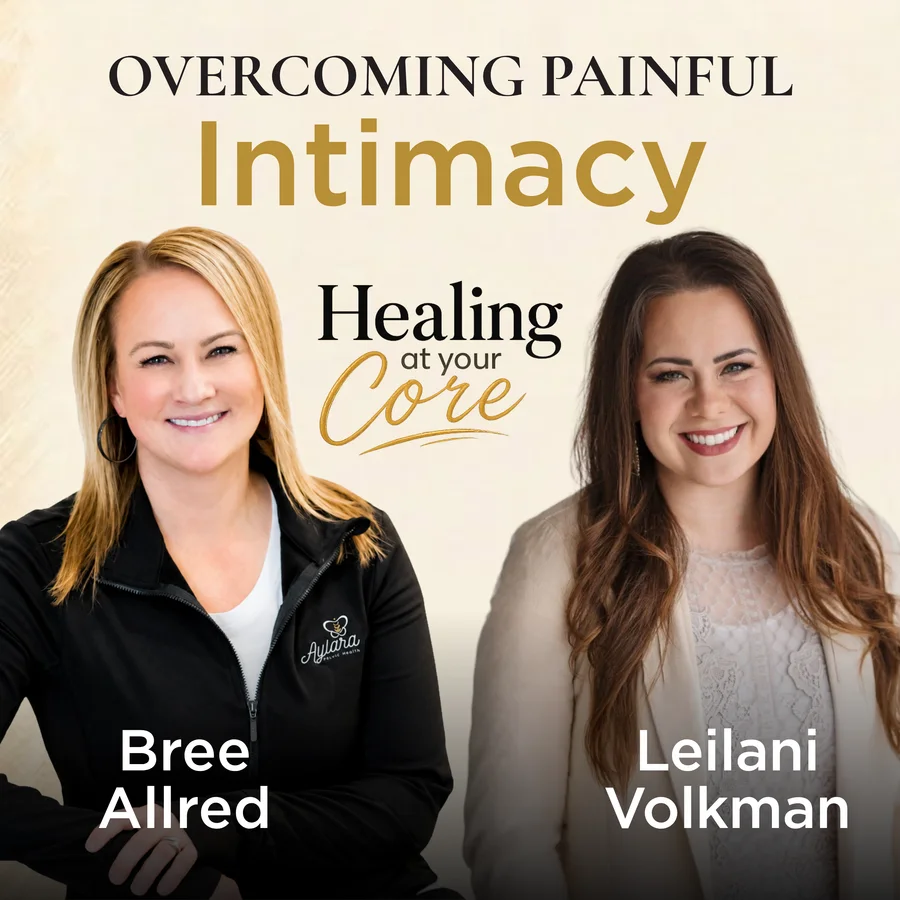
BreeAnn Allred: Welcome to Healing at Your Core. So today we've got Leilani Volkmann with us, and Leilani is, uh, very dear to my heart.
She has, um, experienced pelvic floor physical therapy, and I wanted her to come on and share her story, to see the experience that it can be, and to talk about the difference it can make in lives, and to talk about, um, I don't [00:02:00] know, sometimes people, I think, are hesitant to come in for pelvic floor- Well, yeah
physical therapy.
Leilani Volkman: Of
BreeAnn Allred: course they're hesitant. So kind of talk about that as far as, um, d- just kind of normalizing it and giving them your- Oh,
Leilani Volkman: for sure ...
BreeAnn Allred: perspective and
Leilani Volkman: experience. I don't think anybody really can comprehend, one, like what's the point, two, what's it gonna be like, do I really need it, all of that.
BreeAnn Allred: Yeah. So. So yeah. Okay. Well, just introduce yourself. Okay. Tell
Leilani Volkman: people about you. Okay. Well, um, I'm very casual, so I'm like,
BreeAnn Allred: I- We're just like- Me and Leilani ...
Leilani Volkman: we're gonna just have
BreeAnn Allred: a, a-
Leilani Volkman: I love Bree ... a discussion on the couch I, and okay, so my personality, my name's Leilani. I'm 37. I have three kids. They're super gap, so I've got a 14, a 10, and a four-year-old.
No, she's 15. So, um, and then I'm a realtor. That's actually how I met Bree. Her husband and I work together, and um, he told me that she was a pelvic floor physical therapist, and I was like, "I've been thinking about going to one," and he's like, "She's [00:03:00] awesome," and I'm like, "Well, is she? Let's see." So then I decided to go, and I was like, oh my gosh.
So my personality in general, so I'm an Enneagram 2. On the 16 Personalities, I'm the entertainer, which is embarrassing, but it is very accurate. And um, and then my personality in general, like when I'm picking an OB, in my mind, I know this isn't true, but in my mind I assume all doctors will get the baby out.
What I need is bedside manner. Like I need somebody to be like, "It's okay. You're doing so great." And so for me, like I really am the most open person I've ever met. I- When I move to new wards, I say that I'm like a golden retriever spirit. So the Disney character I identify the most with is Dug the Dog.
That says, "Hi, I just met you, I love you." That truly is me. Um-
BreeAnn Allred: You are
Leilani Volkman: like her to a side. I make friends- I
BreeAnn Allred: [00:04:00] agree
Leilani Volkman: with that ... every-- I find friends everywhere, and I, uh, to my core, my belief is the more open you can be with people up front, the quicker you can become best friends. So like, I'm going to talk as if my best friend is here, so I'm gonna say very open things, talk about clit and orgasms, and like all the things, but in my mind, I'm like, "That's why you're here.
You came to find this podcast because you want all the details." Like, so this is how I talk with my best friends, and the thing is, is like to me, it's so important to find those girls who need this discussion. Because like I've been open-- So I got married at 19, um, and I had painful sex for 13 years. 13 years.
And the thing is, is I think a lot of people are like, "Oh my gosh, was it so awful?" And [00:05:00] it's not like it hurt the entire time, and it doesn't mean I didn't have good sex at different points, so it wasn't like awful always. Um, so to me, I think it's just so important to talk about it because I've been open the whole time, and I haven't actually found many girls that have had painful sex.
I've only found like maybe two or three my whole time I've been married. And so to me, the reason I'm so open is because The girls that do have painful sex, they don't know who to turn to. So I tell every girl that I talk to about this, if you ever come across a girl that it hurts, you need to tell them that they have to go to pelvic floor physical therapy.
Because, like, I literally had no idea. So I got my degree in psychology, um, [00:06:00] and I was referred by... I went to an OB to get checked out. Like, it, sex hurt immediately from the time I got married from then on. And so, like, I went to an OB, and, um, she told me it was all in my head. Because, like, even my premarital exam, like, I was so smooth and so calm that the lady, the doctor was friends with my mom, and she's like, "Has she had sex before?
Because she is so calm." And I'm like, "
BreeAnn Allred: Yes, I'm gonna build a-" So
Leilani Volkman: amazing. And it wasn't like that at all. And so I was like... So I went to this other OB. She checks me out, and she says it's all in my head. And I was like, "I have a degree in psychology And so that was so hard to hear because I'm like, "Well, that did nothing."
Like, she's [00:07:00] like, "You just need to relax more. You need to use more lube, and you need to just be more calm." And I'm like, "I've tried all the things. I've tried it all." Like, I would talk to everybody. I would talk to my friends, I would talk to my mom. I would get advice, go and try it, and nothing worked. So the reason I actually found out about Bre is because of social media.
Like, I started... My social media started becoming more open or, like-
BreeAnn Allred: It started listening to you, to having- Yes ... these contraception? I don't know.
Leilani Volkman: I don't know. Maybe. But, like, I literally didn't know pelvic floor physical therapy was a thing until about a year before I found you. So you had said it's been around for 20- It's been around for
BreeAnn Allred: 20 years.
But it- So
Leilani Volkman: it did not get any publicity.
BreeAnn Allred: Yeah. Didn't get any publicity.
Leilani Volkman: No attention. Like- Yeah. I've talked openly forever.
BreeAnn Allred: COVID definitely, and social media kinda opened up-
Leilani Volkman: Oh, really? ... these
BreeAnn Allred: discussions
Leilani Volkman: a lot. Like, a lot of... I started finding accounts about pelvic floor, and [00:08:00] then I would watch the reels and it would be like, "Oh, if you're painful, da, da, da, da, da."
And I'm like, "Oh my gosh, I think that's what I need." So then I found Travis, her husband, um, and he was like, "You should go to her." So I did. Um, one of the hard things, like, I'd had painful sex for so long that, like, I was willing to do anything. Like, honestly, I would joke and I would tell my friends that I'm like, "I'm ready to have sex in front of somebody," and, like, in front of a doctor- Is that what we're doing?
Okay, help me. ... if they, like, if they can solve... Like, I'm like, I know it's not going in my belly button. I'm not even trying to have butt sex. Like, I don't know what's wrong. Nothing... Like, why is it hurting? And so, like, I was willing to do anything, but, um-
BreeAnn Allred: You'd gotten to that point where you were so desperate to get help.
Oh, for sure. That you
Leilani Volkman: were
BreeAnn Allred: like, "I will try whatever you
Leilani Volkman: ask." Like, when I help people and they're like, "14 years," and I'm like, yeah, like, it's crazy. Like, a lot of people... I, I always want to just, like, say upfront, like, this has nothing to [00:09:00] do with my husband. Like, he was so kind and so loving and so patient.
Like, our sex was, like- He would take however much time it took to, I don't know. So like, to me, it is not a reflection of, like, an impatient, um, self-centered husband or anything. Like, I don't think I could really have a kinder, more patient, loving husband. And I think, to me, that's what was so sad, is like, I don't have a husband who deserves this.
Like, this is like a punishment to him to have such a sucky sex life. So-
BreeAnn Allred: The worst things you've been given before was, like, "It's in your head." Yeah. "Do more relaxation stuff. Use more lube." Right? I think- Did you get other people- No ... telling you different things, or
Leilani Volkman: was that mostly? Like, they would say different positions.
I do know, for me, I do have a tilted pelvis.
BreeAnn Allred: Tilted uterus.
Leilani Volkman: Uterus. Mm-hmm. And so I would just always, like, "Well, maybe it's that." And I did have [00:10:00] all three C-sections, so I never like,
BreeAnn Allred: um, made bigger- 'Cause sometimes they'll be like, "
Leilani Volkman: Oh,
BreeAnn Allred: just wait till after you- Yes ... you have your first baby,"
Leilani Volkman: and then it'll be like that.
Yeah. So it wasn't that. And, and I had C-sections not because I was so tight. I had C-sections because I had a bone in the way. So it wasn't that. But what finally pushed me to actually go to Bre was I had my third baby, so she's four and a half now. So I had her in January, and I think we started in, like, March or so.
Mm-hmm. Because my husband noticed, he goes, "Every time you have a child, you, it gets even worse." And so I think either the hormones or something are drying up, we've talked about. But it was finally the worst it'd ever been, and I was like, "Enough. Get out." Like, it just hurts way too bad. And like, so it doesn't mean like every time we had sex I would cry, but there [00:11:00] definitely were times where like I'm just laying there and tears are falling 'cause it just hurts so bad.
And the other thing that's interesting is it's not all the same hurt. Like, it's not just penetration or like sometimes it would burn. Sometimes it was just inserting would hurt. Um, and then other times, like if you hit the wrong angle, like you're literally hurting up internally. Like, I literally remember...
So one of the things that was life-changing was at year eight, I had a friend give me a vibrator, and that was like one of the biggest differences, and then Bree. And so like I... Vibrators I think are such taboo, and I think it's really hard for people to be like, "Oh, we don't need that." And I'm like, "Well, you don't, nobody like needs it necessarily."
Some people maybe do. But like it made such a huge difference. So I [00:12:00] remember, this is another point that I think needs to be brought up is, so I have an external clit, and there's such thing as like an internal clit, right? Is there like a name for it? Well, there's just,
BreeAnn Allred: there's
Leilani Volkman: different- Different anatomy
parts
BreeAnn Allred: of the clitoris. Like, there's what we typically think externally- See, I don't even know all of this stuff ... is the clitoris.
Leilani Volkman: You just shared
BreeAnn Allred: And there's the clitoris actually dives deep and has more, more to it, right? Okay. But then some people are, can get great stimulation intravaginally. Okay. And some people it's more they get better stimulation externally from the clit.
Right. It's actually the clitoris on both accounts. It's just are you- Okay ... accessing it intravaginally or are you accessing it externally?
Leilani Volkman: Well, I still don't know how to access intravaginally. Um, so but like I had friends who they were like during penetration they could have orgasms because it's getting stimulated that way.
BreeAnn Allred: Yeah.
Leilani Volkman: I've never been able to do that. But the surprising thing is like I can have endless external [00:13:00] orgasms with a, um, vibrator, and that does not equal that I won't have painful sex. So I think that's really shocking when I tell people. Kind of a myth that it's
BreeAnn Allred: like, oh.
Leilani Volkman: Like, I'm like, I can go constantly if my external clit is stimulated.
Like-
BreeAnn Allred: But you struggled still ...
Leilani Volkman: it that, but I still had painful sex.
BreeAnn Allred: Yeah.
Leilani Volkman: And so, like, I think that is something that's like, really? That's even possible?
BreeAnn Allred: No.
Leilani Volkman: Um-
BreeAnn Allred: So emotionally, where were you? How was this affecting your marriage? Did it, like- Oh,
Leilani Volkman: it's just awful. Like-
BreeAnn Allred: Paint a little bit, I know we've got, okay, it's painful, but what were your feelings about yourself, about your- Well,
Leilani Volkman: the thing is what's so funny- Just kind of paint a little bit of a picture- Yeah
where you were at that stage- Um ... when you were seeking care. So what's interesting is, so now it's been four years since I got help, and it only took about eight sessions I think. Probably around there. Knew
BreeAnn Allred: it
Leilani Volkman: was not [00:14:00] very
BreeAnn Allred: much. It, it depends on the person. 8 to 12.
Leilani Volkman: Okay. So I remember thinking, "If this takes a year of therapy, I don't even care."
Like, it is better to be working towards that. If, if I could know that this would work, I would take however long it took, but it only took eight sessions. But what's interesting is now that I don't have painful sex, I still don't even have, like, a high sex drive. And so you're like, "Where were you?" And I'm like, "I'm still in the same place mentally, where I still feel like I suck as a wife 'cause I'm not having it often."
And, like- I don't know. Like, that's, like, pretty much baseline. But, like, I think as far as the emotions beforehand, I would get nervous, I would postpone, I would, like, how do you have, like, a super ... I'm super touchy. I'm, like, probably [00:15:00] the most touchy person I know, so I'm like, that's confusing to be like, "I wanna touch, but I don't wanna initiate sex, and if we initiate sex, then I'm, like, really scared."
And so it's like,
BreeAnn Allred: I don't know. What's
Leilani Volkman: it
BreeAnn Allred: gonna lead to, and-
Leilani Volkman: Yeah, and then it's like, well, I also don't want him to, like ... I don't know. I don't know that he and I have ever, like, actually addressed, like, how much I shut down or, like, his feelings, like, if he's, like, actually been hurt. He's been really good, 'cause he never, like, manipulated me or to, like, "If you loved me, then you would have sex with me more."
Like, he, I don't know if he actually has that internally going on. I've, I've asked him and he said no. But, um, so I'm like, really it's just all awful emotional-wise what you're thinking, like, beforehand, like-
BreeAnn Allred: Yeah ... you just feel like crap. Towards, like, how do I do this? What's wrong with me?
Leilani Volkman: Yeah.
BreeAnn Allred: So anyway, and
Leilani Volkman: then it's, um- Well, and all of my friends, [00:16:00] somehow I have only found best friends who have the highest sex drives ever.
Like, all of ... Like, I literally was naming them in my head as I was coming over, and I'm like, all of my closest friends desire it daily. And I'm like, I'm happy if I have it, like, once a week, like, if that. Like- Which is a whole other discussion ... my husband will watch this and he will be like, "Are you kidding me?"
Like- But it's a whole other discussion, though, to where- ... if I'm happy if I have sex a month ...
BreeAnn Allred: pelvic floor physical therapy is doing a great job at addressing the emo- or the physical side of things.
Leilani Volkman: Yes.
BreeAnn Allred: That there is still, and there's some brain-body connection that we're working with- Yes ... your nervous system to be safe to allow- Yeah
things to be where we want them to be. But it's also still that it's, like, the brain is a big component- Yeah ... in what's happening in the sexual response and the desires and things there. For sure. And that I'm like, we'll have some other guests on, too, that are gonna talk from that side- Yeah ... that can help.
So it's like if you're a high desire versus a low desire partner- Yep ... and how that affects [00:17:00] things, and then also how the plain- the pain can play into that as well.
Leilani Volkman: Well, so one thing, I can't remember what you call it. Do you call it caveman brain?
BreeAnn Allred: Mm-hmm.
Leilani Volkman: Okay. So one thing that I- Like, when you start with her, there's a questionnaire that's evaluating where you're currently at, and one of the questions was, um, "Does it hurt to insert a tampon?"
And my answer was like, "No, not at all." Like, you just shove it in, and you get in, and like, on with your day. And so what is so interesting, and it was the saddest, most validating... See, I'm, like, being really open and honest. But, like, it was the most... It was so sad, because Bre has different dilators that, like, start, like, the size of your pinky-
BreeAnn Allred: Mm-hmm
Leilani Volkman: and then they work up to, like, I don't know, like that
BreeAnn Allred: big. The varying ranges of an erect penis.
Leilani Volkman: It is, like, like, really giant. And so, um, I remember at one of our first appointments, she pulled out the [00:18:00] pinky-sized dilator, and that hurt. And I remember being like, "Okay, this is so validating that no wonder why my husband that's, like, way bigger than that is going to hurt, if this size hurts."
So the other thing that I always tell my friends, if they're going to go to a physical therapist is for me personally, it was important that I went to Bre who actually used her finger instead of just actual dilators because what would happen is with the caveman brain, do you wanna explain what that means?
BreeAnn Allred: Sure. Yeah. Okay. So nervous system plays into responses in our body, and sometimes the brain will be the primary driver, and sometimes the body will be the primary driver, but then they feed a cycle. So your caveman brain's job is to scan for survival risk, right? Its job is to keep you alive. Protect. It's to [00:19:00] protect you from danger.
And so it's, and it's really, it's like, "Yep, that's gonna kill me. We're gonna shut that down. Oh, that's good. That'll keep me alive," right? And allows and kind of really filters things from, like, "Can I survive this?" Uh, pain generally from that caveman brain will stimulate a protective response because pain means bad, something's getting damaged- Yeah
or the brain perceives it that way, so it will elicit a protective response. So when we're talking about your caveman brain and painful intercourse, we say, "Okay, insertion causes pain." What does the caveman brain say? "Hmm, that's probably gonna kill me or at least doesn't feel good," right? And so then it protects against it and creates muscle responses to prevent that from happening.
So
Leilani Volkman: what was so surprising to me was in my mind, in my logical mind, I thought, like, "Oh, it's not that bad." Like, I'm able to have sex. I have talked to some girls that [00:20:00] they can't even insert a tampon. Mm-hmm. And I was like, "Well, I'm not that bad. Like, I know I'm not as good as all my friends that are, like, having it three times a day, so, like, obviously, like, I'm not as good.
I just need to keep pushing through. It'll be fine." But what was interesting, and the reason why it's so important that you find a therapist that uses their finger, is when she would insert her finger With a glo- glove on, um, I would tighten up immediately, and she would be like, "Okay, you need to release."
And I'm like, "I tightened?" Like, I had no awareness. Because it's all part of our muscle. I had no idea. Yeah. Like, to me, it was completely disconnected. Like, I had no idea if I was, like, resting, standing tight. Um, so that was one thing that was really interesting is one of our very first, um, things that we worked on was learning how to even loosen.
Like, everybody always talks about Kegels and, [00:21:00] like, tightening.
BreeAnn Allred: And they're the answer for everything.
Leilani Volkman: Yes. Everybody just thinks you just have to do Kegels. No, that's not what I needed. I had to learn what the opposite of a Kegel is. So, like, we would talk about how, like, your pelvic floor is here, and I remember at the very beginning when I learned how to loosen, like, it would come down forever and ever, like you would call it an elevator.
And at the ver- like, I could literally, once I was finally in tune, I could tell, like, when I'm just standing there, like sometimes, like, you'll hold your breath or, like, you suck in your stomach while you're standing or whatever. Like, I would just stand with my pelvic floor tight. And so At the end of our treatments, like, I would only, like, just barely release and it would be done.
And so, like, that was really fascinating to me, that like my resting state's like... Like, or like another example is like a lot of people have their [00:22:00] shoulders up high- Mm-hmm ... and you're like, "Kate, release. It's okay." Yeah. So that was, that's what I always tell my friends now currently, like, if you think you might have a tight pelvic floor, just start learning, like, doing the opposite of a Kegel many times a day.
Like, you had me do it, like, every hour, just to like start getting in contact or-
BreeAnn Allred: To kind of re- where you said, like, you were totally disconnected from
Leilani Volkman: that area of your body. Yeah. In order to
BreeAnn Allred: connect back. It's like to reconnect it back and then almost retrain it, like, this is actually where we should be resting,
Leilani Volkman: not up here.
Is just like the... Yeah. So that was important.
BreeAnn Allred: Yeah.
Leilani Volkman: Okay.
BreeAnn Allred: Um, let's talk a little bit about, and I'll just kind of touch base on how- Yeah ... your nervous system plays into this. Yeah. Right? Um, sometimes going to see doctors can be a little scary, right? Yeah. And we are talking about things that a lot of people don't talk about.
I know,
Leilani Volkman: Bri.
BreeAnn Allred: And like, we're so good.
Leilani Volkman: I know.
BreeAnn Allred: But it is that idea of like your nervous system, your brain has to feel safe. [00:23:00] For sure. And I'll give people, I guess, a little n- different description of the caveman brain- Yeah ... like we were talking about. I always still say that the brain's on scary movie mode.
Leilani Volkman: Yes.
BreeAnn Allred: So if you've watched a
Leilani Volkman: scary movie- That one's a good way to, yeah, that's a good way to-
BreeAnn Allred: I'll, like if you do it at night especially, right? And then you're like, "Um, what was that noise?" Uh, you're- And you're like, "Oh, what was that? Oh." You're like on edge. Yeah. You like hear everything, you're hypersensitive, you're-
Leilani Volkman: Yeah
BreeAnn Allred: a, like hyperaware of everything that's happening when it's like-
Leilani Volkman: Yes ...
BreeAnn Allred: if you haven't watched a scary movie- Yeah ... you're just doing thi- doing your thing, right? Yeah. You're falling asleep- Things go ... or you're doing whatever.
Leilani Volkman: I call it being on rope's end.
BreeAnn Allred: Mm. Like,
Leilani Volkman: any little things can set you off. That
BreeAnn Allred: just sets it off, and I think that's a great explanation for-
Leilani Volkman: Yeah
BreeAnn Allred: like, I'm like, it's the brain in combo with the body responses. Yeah. But it's like the brain's hyperaware of anything being around that vaginal area.
Leilani Volkman: Whether you logically know it or not.
BreeAnn Allred: Yes. Like- And it will respond by being extra jumpy- Yeah ... and then kind of protecting against that fear or that, do you know what I mean?
Yeah. Perceived [00:24:00] threat. So- Yeah ... getting the nervous system to kind of calm down, and then we can do that- Will come, like- ... from the ner- from the muscle side too ... muscles that
Leilani Volkman: are safe. Like, one thing that you would do, I forgot about this, but now that we're talking about it, is you would insert your finger, and I'd freak out, and then you'd be like, "Okay, see if you can calm down."
And it took a while to learn, and then I would release, and you would be like, "Okay, so we have to honor our body. I'm gonna pull back out." When you're ready, we'll redo it again. And then it's like your body, you're gaining trust and helping your spirit know like, I'm going to listen to you. I'm not gonna force you to do something that you don't feel unsafe.
BreeAnn Allred: Because if you push through and you force through, what does the brain then say? Breathe or- I sent you a danger signal. You didn't listen.
Leilani Volkman: Yep.
BreeAnn Allred: And now I'm going to reinforce that protective response- Yep ... even stronger. So you have to kind of, it's this... [00:25:00] And I even tell people, I'm like, 'You're doing this even with your own inner caveman brain.'
Right? Yeah. You're like- Sure. For sure ... I hear you. I see you trying to protect me. And now I'm going to say-
Leilani Volkman: Yeah ... '
BreeAnn Allred: Okay, I hear you. We're listening, and we're gonna try this and see if we get a different response.' And then the inner brain's like, 'Oh That didn't hurt as bad. Okay Yeah I'm trusting you a little bit- Yeah
because you listened to me, I was willing to give a little bit Yeah And then you create a different experience that then feeds a different cycle.
Leilani Volkman: One thing that I always, one thing that I was surprised about that I think's worth mentioning is even after, um, w- I completed our stuff, I still had the scared feeling and nervousness for six months after.
BreeAnn Allred: 'Cause
Leilani Volkman: it was writing- 'Cause I watched and- ... a new
BreeAnn Allred: story ...
Leilani Volkman: yes. So I never once had painful sex, um, since then, but the apprehensive feelings to have sex [00:26:00] lasted about six months. So it wasn't immediate, and it didn't take forever, but
BreeAnn Allred: yeah. It takes, it just takes time to rewrite that new story. To just
Leilani Volkman: be like, "No, you really are safe.
It really doesn't hurt. You really are okay."
BreeAnn Allred: Yeah. So it creates a different experience there. So that was a
Leilani Volkman: surprise to me- Yeah ... how long it took. 'Cause I thought, like, "Oh, it doesn't hurt at all. Why isn't it, why am I still so nervous to do it?"
BreeAnn Allred: Yeah. And I think it's that you had 13 years of writing the one story.
Oh, for sure. And we had to kind of unwrite it in therapy-
Leilani Volkman: Yeah ...
BreeAnn Allred: and then rewrite the new experience that your brain would trust.
Leilani Volkman: Yeah. Mm-hmm. Yeah, for sure.
BreeAnn Allred: Yeah. And then there's only, and like I really address a little bit of the nervous system responses, and we address a lot of the physical side. But sometimes- Yeah
there is still a little bit more from a psychology perspective- One another ... to heal that relationship there and to continue rewriting that new story.
Leilani Volkman: I think another thing that's interesting that I noticed is, like, if you're [00:27:00] into energy work of any kind, like, when you, like, release, like, a big thing, sometimes, like, you'll cry or, like, get really tired.
It's like a release of emotion. And I remember after some of our, um, sessions, I would be, like, exhausted, and we didn't do anything. Like, we're literally- You're
BreeAnn Allred: like, "We didn't go have a, a huge workout in the gym."
Leilani Volkman: Yeah. And so, like, but I remember being like, "Whoa, I'm, like, exhausted." And then I figured out, like, it's because we're, like, releasing that energy, and we're letting it go, and it, like, it was, that was really interesting to me.
Yeah.
BreeAnn Allred: So amazing.
Leilani Volkman: Oh, yeah.
BreeAnn Allred: To have just a new experience with it, and also to understand that it's like, okay, we're doing a lot of stuff here.
Leilani Volkman: Yeah.
BreeAnn Allred: Right?
Leilani Volkman: Yeah.
BreeAnn Allred: Emotional, brain body connection. There is a book called Body Keeps the Score, [00:28:00] right? I- It's like emotion can be stored in
Leilani Volkman: different ways ... it's too technical that I haven't read it- Yeah
but I'm all into it
BreeAnn Allred: But the concept of it is this idea, it's like sometimes- Yeah ... the body will store emotion that the brain doesn't even know about.
Leilani Volkman: Oh, for sure. Yeah. For sure. So yeah.
BreeAnn Allred: Yeah. Um, my, one of my guests described it, I loved it, and she's like, "It's that like gut instinct." Do you know what I mean?
Like- Yeah ... you feel it before you know it.
Leilani Volkman: Oh, yeah.
BreeAnn Allred: And it's kind
Leilani Volkman: of that concept. See, and I'm so detached, I like don't have red flags go off. Like- ... that's not my gift. Too fun.
BreeAnn Allred: Okay, so if there, if you can remember a little bit, like describe your experience. Um- Okay ... if somebody is nervous to go see a pelvic floor physical therapist for this issue- Oh, for sure
because they're like, "Oh my gosh, what are they gonna do?"
Leilani Volkman: Yeah.
BreeAnn Allred: Right? Um, just explain kind of like what was your experience, and- Okay ... um, maybe what were some of your fears, and were those fears realized, or did it, did it, what was your experience like?
Leilani Volkman: Well-
BreeAnn Allred: So I just like kind of like- Yeah ... what to expect on their [00:29:00] first visit from your perspective.
Leilani Volkman: I'm like, can we remember? Yeah.
BreeAnn Allred: And I can kind of help with that- Yeah ... a little bit too, but, um, but that idea of like, okay, like it's really not that scary, even though- Oh, yeah ... it seems like it is. Um, it can be very vulnerable, but also pelvic floor physical therapists are trained in a way to be able to hold that space and that- Well-
vulnerability and
Leilani Volkman: need it ... so what I was saying is like my priority when I pick an OB is just their bedside manner. Because like I'm super touchy, I'm super like, you can tell like emotional. Like, I show love like so easily, so I really need that. I don't think I could... I'm sure I could, but like I... This probably was the most vulnerable thing, and I don't even get embarrassed.
Like, and I was nervous, and so I needed somebody to be very like loving and, and I... [00:30:00] You were exactly what I needed. And, um-
Like you, you matched my energy, so I'm sure like if you had somebody who wasn't as like needy as me, you wouldn't be like that, but you were what I needed. And so I needed reassurance. I needed you to talk me through things. I needed like, I don't know, like I think it takes a lot to match the type of kindness that I need , you know?
But, like, I think the first appointment, I don't even know if I can remember, but you go in, um, I'm sure you talk for a little while, and then she leaves the room, and you get dressed- undressed from the waist down
BreeAnn Allred: Basically like you do for a gynecologist.
Leilani Volkman: Yeah Mm-hmm And then you cover up, you lay on the table, and she comes back in, and then I don't really remember-
BreeAnn Allred: So like from then on
Leilani Volkman: from then on what happens at the first [00:31:00] appointment.
BreeAnn Allred: And I'm like, a lot of times the first appointment, and it's really about, again, meeting your body where it is. Like some people- Yes ... we're starting- Some people are not ready to
Leilani Volkman: like- Like may not
BreeAnn Allred: be ready for some open touch Yeah So w- a lot of times we're gonna talk, we're gonna explain what's going on, which often- Yeah
is that scary movie mode with muscle responses happening with it Yeah Um, kind of- Yeah ... addressing what we're gonna be doing, but we'll start a lot with some breathwork and connecting the breath to the pelvic floor, and educating how to release and relax the pelvic floor. Then we may move to, like, some external touch where you're still fully clothed.
It's like, "Okay." Oh, okay. "
Leilani Volkman: Can I touch your belly?" See, I was ready. I was like- No,
BreeAnn Allred: you're good ... "
Leilani Volkman: Let's
BreeAnn Allred: get it."
Leilani Volkman: And at first, like you
BreeAnn Allred: were ready for that on your first visit, so we did it. But some people may not be.
Leilani Volkman: Yes,
BreeAnn Allred: yes. Um, but it might be like, "What if I touch your lower belly?" Yes And then what, what response do you have?
Well, yeah, that's that- Some people get, like, nauseous, and they're like- Yeah ... "Ugh, I don't feel good" Just as simple
Leilani Volkman: as
BreeAnn Allred: that And we can feel tension there, so we can work through that. Or, so it's really about meeting your body where it is. Again- Mm-hmm ... because if we force anything,
Leilani Volkman: we get- We do not- ...
BreeAnn Allred: a body resistance
Leilani Volkman: make [00:32:00] progress.
BreeAnn Allred: Yep. Yeah. So we're building those trusting relationships, and it can be there. So it's about meeting your body where it is.
Leilani Volkman: Yeah
BreeAnn Allred: And then eventually the goal, if we're trying to have some penetration, whether that's using a tampon or participating in intercourse, or just, I mean- Yeah ... having a pelvic exam for health reasons that you're struggling with, it's about meeting the body where it is.
It's getting some external touch to the vulva and vaginal regions, and then slowly progressing with some graduated insertion, meaning that- Yeah ... the dilators may come in, we're gonna start something small and light. We're feeling for muscle responses. We're stopping when the body asks us to stop, whether that be a muscle response or doing it, like the dilator won't go in.
It's like, well, yeah, your body is preventing that from happening, and if we force it, it will respond with increased protection. So-
Leilani Volkman: Yeah ...
BreeAnn Allred: it's meeting that body where it is, teaching new skills like relaxing those muscles, quieting the nervous system with, we'll use, like, some vagal nerve techniques, which are crazy things, but it's a big thing that forces you more into a rest and digest nervous [00:33:00] system state, and kind of meeting the body where it is, and then progressively increasing sizes of what we're inserting, allowing for light stretch, learning how to relax into stretch, which can be helpful for childbirth for different reasons, right?
Um- And then getting to the point where you're able to insert a certain dilator size and have repeated insertions- Yeah ... to mimic motions of intercourse so that the body can help there.
Leilani Volkman: Yeah, not just like a one time. Yeah.
BreeAnn Allred: And I always tell my clients, I'm like, "My goal is not in your arousal," so usually things are a little better.
D- we're taking it very scientifically.
Leilani Volkman: Yes.
BreeAnn Allred: Um, and kind of educating- Yeah ... from a physical exercise based type standpoint, and then when the body is in more of an aroused state, we are just in a better spot- Yeah ... where it's like you have more lubrication, better blood flow, a little bit increased flexibility of tissues, so things should be better, um- Yeah
in that environment when you're in those situations, that then you use the tools that you've gained in that physical therapy session- Yeah, that's true ...
Leilani Volkman: in those situations.
BreeAnn Allred: So, [00:34:00] and then progressing from there, and there are some peoples that have difficulties orgasming. That wasn't your situation, but muscle tension can contribute to that.
That you can help with. Yeah, we can help with that from either a muscle strength or a muscle tension standpoint.
Leilani Volkman: Okay. Interesting.
BreeAnn Allred: And just an interesting kind of open discussion- Well ... to where it's like we can address lots and lots of issues related to intercourse difficulties, whether that be pain or
Leilani Volkman: orgasm difficulties.
Okay, so that's my next question, is can you help people find their G spots?
BreeAnn Allred: Sometimes.
Leilani Volkman: Okay. That's my next thing that I'm like, "You know, I think I would like her to help me," because we can't find it.
BreeAnn Allred: I know, it's so interesting. So. But sometimes, and sometimes anatomically- Oh, really? ... you may not have one Okay
AKA. So
Leilani Volkman: This, that's the question everybody wants to
BreeAnn Allred: know. I'm like, we'll talk about it, right? I need my models. I don't have them here with me. It's terrible. Ah. Um, but the idea of, okay, we think of the clitoris of the external little bulb- Yeah ... that's there, but it does go, there's a cruris and there's a bulb that go deep.
Okay. And the vagina sits in the [00:35:00] middle of the clitoral bulb, okay? Okay. Um, versus the g- the glans, which is the head, um, that we see when we're thinking like, "Oh, that's my clitoris," and you see it on the outside- Yeah ... externally. And so based on how your clitoris is oriented with your vaginal canal-
Leilani Volkman: Okay
BreeAnn Allred: it's easier to access for some- Oh ... versus others, right? And if it's oriented a little bit more deeper away, you may not be able to access- Okay ... that point very well. So it's- That's- And some women are like, "Oh my gosh, I'm broken." And I'm like, "No, it's anatomic
Leilani Volkman: variation." Actually not your fault.
BreeAnn Allred: Yes. And when we're talking about-
Leilani Volkman: It's the way you were born
BreeAnn Allred: when we're talking about orgasms as well. Yeah. Right? There's different types of orgasms. We don't realize this. I, yes. But there's like, there's coregasms, there's clitoral orgasms, there's vaginal orgasms. There's- Okay ... different things of different parts of your body that may be stimulated when you're having an orgasmic release, and just learning those different parts of your body can be helpful for some.
But I even tell people from a climax perspective, there's some [00:36:00] statistics that 10% of women will climax from vaginal stimulation alone.
Leilani Volkman: Okay.
BreeAnn Allred: An additional 20% of women prefer clitoral and vaginal stimulation together to orgasm, and 70% of women want external clitoral stimulation alone for orgasm.
So-
Leilani Volkman: Okay
BreeAnn Allred: it is a preference, and I just look at those statistics. It means that however you achieve climax is good.
Leilani Volkman: That's great. And
BreeAnn Allred: if you are one of those women that prefer more external clitoral stimulation, you are actually in the norm-
Leilani Volkman: Okay ...
BreeAnn Allred: of 70% of women, do you know what I mean? Achieving climax through that type of stimulation.
Yeah. And then 30% of women, do you know what I mean, also prefer some vaginal stimulation or vaginal stimulation alone.
Leilani Volkman: Yeah.
BreeAnn Allred: So I just love to kinda, 'cause we all think we're like, "Oh, I'm not having a climax with vaginal stimulation." For sure. And I'm like, and that is true for 30% of women.
Leilani Volkman: Yeah.
BreeAnn Allred: And there's 70% of women that it's like, that's not how they achieve climax.
Okay. And all are perfectly acceptable and normal. [00:37:00]
Leilani Volkman: Yeah. One thing that blew my mind was, um, like I could never... The reason I brought up, um- vibrators was because before I had a vibrator, I could never do doggy style. Like, I was like, "Get out. I am going to throw up." Like, I literally felt-
BreeAnn Allred: Those visceral responses
Leilani Volkman: like I was having, um, I was having, like, labor contractions. Like, it hurt so bad that I was like, "We are never doing that again." And then when I got a vibrator and I would, um, stimulate the clit, then I could do doggy style and it didn't hurt at all. But when I was first getting the vibrator or first using it, I would take the vibrator off and I would go back into like, "I am going to throw up, it hurt so bad."
Then I would put it back on and I'd be like, "I feel nothing. Like, I feel crazy. This is so different." And [00:38:00] I had a nurse friend confirm or deny, but I had a nurse friend who said when the clit is stimulated, your, like, organs will, like, move out of the way because it knows what it's doing and it's trying to, like...
Is that true?
BreeAnn Allred: There's for some, and for others not. Oh, okay. But this is where I'm like, it's so hard that it's a normal-
Leilani Volkman: Oh,
BreeAnn Allred: okay ... do you know what I mean? There's a whole normal range
Leilani Volkman: of things. I just think it's good to know whether it is
BreeAnn Allred: or- But part of arousal is that the uterus will lift and the vaginal canal will lengthen a little bit.
Oh, interesting. So, yes. And so when you're having some clitoral stimulation, do you know, your body was probably- Interesting. Okay ... allowing for increased arousal and a little bit more of an 'Cause I
Leilani Volkman: was like, I could never do that. And then now I'm like, "That's my favorite one." It is so crazy how different, like...
But, like, if you're, for me, like, I needed the vibrator so that I could be aroused While he was- Or
BreeAnn Allred: play with it was
Leilani Volkman: happening ... because it's not, like- Play with things that- ... getting stimulated-
BreeAnn Allred: Yeah ...
Leilani Volkman: if he's back there. Yeah. You know?
BreeAnn Allred: Yep.
Leilani Volkman: So [00:39:00] it's just so-
BreeAnn Allred: So it's just- ...
Leilani Volkman: weird ...
BreeAnn Allred: and this is where it's like everybody's sexual response is unique, and so-
Leilani Volkman: Yes
BreeAnn Allred: just this is where a lot of the, like, various recommendations and positions and use of- Yeah ... d- vibrators or other different sex toys to kind of help, um, promote- Yeah ... or support that sexual response are beneficial for people. Yeah.
Leilani Volkman: Another thing that I thought was interesting is you, what was your favorite recommendation for a lube?
BreeAnn Allred: Oh, so it really depends on the person and- Oh,
Leilani Volkman: really? Okay ...
BreeAnn Allred: but there are multiple lubrications. I have women that are sensitive to lubrications. Okay. They're, it can create some burning. It can create different things from the lubrication itself. So there's really individual recommendations, right? Okay. But silicone can be irritating to some.
Okay. But silicone is generally a little longer lasting. Okay? Especially if you're needing something that's a little more waterproof, 'cause you're- Right. Do you know what I mean? Okay. In the shower, you're doing things there.
Leilani Volkman: Yeah.
BreeAnn Allred: But, um, we really try to go for clean products. Um-
Leilani Volkman: Yeah ...
BreeAnn Allred: there's a lot of different types, but-
Leilani Volkman: That [00:40:00] can be improved
looking at products. Because people don't know, like-
BreeAnn Allred: Yes. I'm like, we'll do a whole podcast on that. Hey, that's a great
Leilani Volkman: idea. I'm like- I remember 'cause I had used Astroglide.
BreeAnn Allred: Yeah, and it has a lot of things in it that can be irritating too. Yeah,
Leilani Volkman: and I didn't know. For some people. Like, you just don't know what you don't know.
BreeAnn Allred: Yeah. So and that's where it is a little bit of an individual, which is- Yeah ... one of my takes on things. I'm like, I think individualized is ver- better than just-
Leilani Volkman: Important.
BreeAnn Allred: Do you know what I mean? It's important- Important ... from those standpoints, 'cause some general recommendations that I may give may not actually work for one person.
Yeah. So it can be there.
Leilani Volkman: One thing that I always wanna say is for me, so I have two daughters, my plan is to take them to a pelvic floor physical therapist before they even get married. Because I think if you can learn within yourself before you're even sexually active to how to relax, like-
BreeAnn Allred: Yeah ...
Leilani Volkman: can you imagine if all of our daughters, like,
BreeAnn Allred: had this- This [00:41:00] toolbox and skill
Leilani Volkman: set
before, then you'll, like, bypass so much.
BreeAnn Allred: And I could even say just a little bit- So ... if, like, if you're struggling with painful tampon use-
Leilani Volkman: Yes, that I have- ... that
BreeAnn Allred: might be a first sign ... that
Leilani Volkman: I have struggled-
BreeAnn Allred: So, like, okay, if that might be a first sign that your body is struggling with some pelvic floor muscle dysfunction, it'd be good to- Well, like,
Leilani Volkman: I think-
look at that ... so for me, any t- time I'm going through something hard, whether that's mental health, like depression, anxiety, or this, like, my mentality is you just suck it up and you deal with it, and if it gets really bad, then I'll address it. And it's like, I went 13 years, like, and I did try to get help, but it-
BreeAnn Allred: People didn't know where to send you.
Leilani Volkman: Yeah. Yeah. And so I'm like, I think, like, even if you have, like, like saying pain with inserting a tampon, I'm like, "Well, like, does everybody have, like, some slight pain, or does it..." Like, like, I've talked to a girl and she's like, "I can't even insert one." And I'm like, "Okay, honey, you need to go." [00:42:00] But, like, for me-
BreeAnn Allred: Sometimes with
Leilani Volkman: proper education
I can
BreeAnn Allred: insert- Yeah
Leilani Volkman: Yeah.
BreeAnn Allred: And that's where I say sometimes it's proper education on how to use a tampon, a little bit of education on how to relax the muscles. But I would say if after the first several times, to, I mean, like, maybe your first three to six months of periods when things have regulated-
Leilani Volkman: Yeah
BreeAnn Allred: and it depends- Yeah ... on the severity and what are your needs and how big are your desires to do this, right? Sooner could always be beneficial.
Leilani Volkman: Yeah.
BreeAnn Allred: But there is those things where it's like, well, if it's still persisting after six months, okay, sure. There, you should be, like-
Leilani Volkman: Sure ... motivated to help.
BreeAnn Allred: And I
Leilani Volkman: think that's good to have, like, a baseline of, like, any time something lasts longer than this amount, then I get help.
BreeAnn Allred: Yeah.
Leilani Volkman: Like, whether that's mental health
BreeAnn Allred: or- Yes, agreed ...
Leilani Volkman: physical, because I think we just, "I'm fine. It's fine. It'll get better." But it doesn't. It's
BreeAnn Allred: like we just ignore it, and it doesn't actually get better.
Leilani Volkman: Yeah. Well, that's at least how I operate, so.
BreeAnn Allred: Yeah. That's where I do. For sure. Okay. So if you were talking to your younger [00:43:00] self- Yes
do you know what I mean? And what would you say to her? What would you do encourage her? So or you've got your younger self, do you know what I mean? Yeah. Out here listening to this podcast, what would you want her to know? What would you encourage
Leilani Volkman: her? Well, first off, just so anybody who does watch this, I really do mean it, like, I am as open as possible.
I think they're gonna link, like, my Instagram and my Facebook. Like, if you do feel alone in this topic, you can for sure message me. We can become friends. We can talk on Marco. We can talk on the phone. We can just chat back and forth, because I think you feel very alone. You don't know who to talk to. Like, I've talked to girls that they're like, "I haven't even told my mom."
Like, I think it's a very lonely thing, and, like, your spouse is supposed to be your person. But even in that, like, you feel kind of alone, 'cause you're the one causing issues, you know? Like, and they don't understand or, you know. I just think it's a very [00:44:00] hard thing to go through. So if you have the personality that you wanna reach out to me, I, my inbox is literally always open.
Like, I share with everyone so that the girls that struggle with this don't, one, that they can find help, and two, so they don't feel alone. Like, that to me is the very most important. Yeah. Because it is so hard, and sex is so important that it's really, um, lonely and scary. Um, so if I was talking to my younger self- I don't know.
I feel like I did everything that I could. Like, I tried to stay open so that I could find help, and I just couldn't find the help. And so I just am so grateful, one, obviously that I found you. Two, I'm grateful that we live in an age, this is one of [00:45:00] the blessings of social media is, you know, like it's, back when it was scary to research all these questions 'cause you're scared you're gonna pull up porn and all this like stuff, and you're like, "Well, I don't know."
But now, like you get reels of symptoms and you're like, "Hey, I identify with that." So that's so, such a relief to get help. Um, but really if I, I don't know what I would say to my younger self. I would show a lot of compassion, but I, I, it's easier for me to talk to somebody else who's first married than to go back and talk to my younger self, which is-
BreeAnn Allred: Okay, so what would you tell them?
Sad ... that's first married
Leilani Volkman: Um, I honestly just think like if you have painful sex at all, and even it's, like we've talked about, it's possible to not have painful sex, and then if you have a baby, it might start hurting. Like, that's also when you can go, because even if [00:46:00] it's been okay at one point, like get help.
Like
BreeAnn Allred: Different experiences can bring up some trauma responses in your body which triggers- Da-da ... that protective response.
Leilani Volkman: Yes So Like I have friends that their labors were really bad, and so then they were really
BreeAnn Allred: scared after So that can cause some things. Yeah There can be mental health contributors, so but yes, if you're ever having painful sex- Yeah
it's like there's things you can do for it.
Leilani Volkman: Well, I think really my final word is just I prayed for years and years for this to be resolved. Like, I really did. And um, and it never was, and I really was hopeless, and I literally thought that's how it would always be. Um And so to me, like I literally, anytime I think about this, like, I'm like, I will do whatever, uh, marketing, whatever it takes for Bre [00:47:00] because she literally changed my life.
And to me, I literally call it the biggest miracle that's ever happened in my life. Like, that I've literally prayed and fasted forever and never got help, and then it's literally night and day. Like, I literally don't have pain, and I didn't even know that could ever even be possible. So I am eternally grateful.
So yeah. Thanks. And I love Bre. Like, everything about her, she is so warm, she is so friendly, she's understanding, she's patient. Like One thing I will say about Bre is I do believe that she has found her, like, God-given gift. Like, Bre in general... So I met Bre and got to know her through pelvic floor, and so I saw this, like, lit up, super compassionate, talkative person, [00:48:00] and then when I would see her outside of pelvic floor with her husband, she was much more quiet.
And I've come to the conclusion that I'm like, "She has found her God-given gift," and when you find that, you light up and you have a desire to help and serve, you know?
BreeAnn Allred: Yeah. That would be- It is a passion of mine, yes, for sure ...
Leilani Volkman: right. So I just, I literally couldn't recommend her more, and she can be what you need.
And it is scary. One thing that is, I remember, like, being so desperate for help, but what was so surprising is the therapy actually did still hurt. And I think I went into it thinking, "Oh, it's going to solve the hurt, so it won't hurt in the process," and I think that's one thing to be aware of. Like-
BreeAnn Allred: It's about pushing your body that little extra
Leilani Volkman: bit
just a titch so that you're learning, like, "Hey, it's okay. We're safe," but, like, I just thought it would be, like, [00:49:00] totally nothing, and I remember being like, "Oh"
BreeAnn Allred: It's still a little bit of work in there ...
Leilani Volkman: you're in denial if you thought this wouldn't hurt at all. But- Yeah ... like, totally worth it. Of course, obviously.
But-
BreeAnn Allred: For sure ...
Leilani Volkman: yeah.
BreeAnn Allred: Okay. Now we're gonna just do some fun fire questions. Oh,
Leilani Volkman: fun. They're like- Okay.
BreeAnn Allred: Love that ... nothing that's, it's more just a getting
Leilani Volkman: to know you, right? That's okay. You can ask me anything ... these are at the end of every podcast we do. I tell everybody
BreeAnn Allred: everything. So, um
You've already kind of answered some of them. Yeah But what would you say is your guilty pleasure in regards to food?
Leilani Volkman: Oh, I love sugar, like-
BreeAnn Allred: In all its forms, or is
Leilani Volkman: there one in particular? Oh, yeah. Well, no, I'm like, I love... I have a really good chocolate cake I make. I love cookies. I'm like s- Okay ... you name it.
I- Peaches, chocolate-covered cinnamon bears. I don't know. Peanut butter M- or not... No, my husband loves peanut butter M&Ms. I love peanut M&Ms. I love all sugar. That's the way I am- I like it ... the weight [00:50:00] I am. You're beautiful. Stop it. I can be beautiful and the weight I am. So.
BreeAnn Allred: You tell me your guilty pleasure in regards to time.
I- How you spend your time ...
Leilani Volkman: feel like I just am very slothful, like I just sit and scroll. That's like... But my husband and I, our favorite thing to do is we love movies. Like, we go to movies. The... See, like I've talked about clits and orgasms, and this is the part that makes me most embarrassed, is- ... the part where I'm like, so some people will go to, like, double headers for their kids' softball and baseball games.
We go to double headers where sometimes we'll go to, like, two or three movies on a Tuesday on the cheap movie days. So awesome. Like, people are like, "I haven't gone in six months." I'm like, "Okay, you're not my person. I can't identify." Like, we just love going to the movies. You love going to movies.
BreeAnn Allred: So great.
Leilani Volkman: See, I'm more embarrassed about that.
BreeAnn Allred: You shouldn't be. So funny. Uh. Okay. Well, thanks for joining me today. Yeah, of course. And for being [00:51:00] vulnerable and just- Oh, that's- ... telling your story ... always. You're welcome. Um, I think so many women are gonna relate to this, and I hope it helps someone.
Leilani Volkman: Well, and if they don't relate, which we hope you don't relate, the point is, is the knowledge makes it so that if you ever come across another girl in your life, you can actually know what to tell them.
BreeAnn Allred: Yeah. Like, we hope nobody relates to this. Like Yeah ...
Leilani Volkman: but there are girls, and we want to
BreeAnn Allred: fight. I want them to be able to find help. Yes. And to- Of course ... be able to look into pelvic floor physical therapy- Yeah ... and change- Oh, for
Leilani Volkman: sure ...
BreeAnn Allred: this experience as well. For sure. Yeah. Yeah. Well, thanks, Leilani.
Leilani Volkman: Okay. I love you.
Love you. I love her. And you will love her. I don't... Everybody that goes to you, I'm sure, loves you. Well, thank you. So yeah.
BreeAnn Allred: You're sweet.
Leilani Volkman: Thank you.
BreeAnn Allred: Thanks for joining us for this episode of Healing at Your Core, and we're looking to help you heal your core.
Narrator: Millions of women are still waiting for someone to take their symptoms seriously.
You found this show. Share it. New episodes of Healing at Your Core release every week. [00:52:00] Evidence-based, non-surgical, and built around one belief: You do not have to live with this.